
Steve Collins isn’t wearing shoes when I knock on his office door.
His beard sits somewhere between professorial and frontman, and the room itself feels less like a workplace and more like a curated collision of worlds, as synths lean against bookshelves and cables coil around stacks of journals and trinkets.
It isn’t what you would expect of the Chair of Media and Communications at the School of Communications, Society and Culture. But then again, Collins isn’t your typical academic.
“I never really set out to do this,” he says, gesturing vaguely at the office, the university, and perhaps even the idea of academia itself.
Collins’ path to Macquarie University was never a straight line; it instead followed a series of creative detours, each step shaped by curiosity rather than convention.
The same attitude also defines his teaching, where he blends technical skills and critical thinking across subjects as diverse as web design, digital media, and copyright law.
Once he steps outside the lecture theatre, Collins shifts into an entirely different register.
Known in the underground industrial music scene by names like INfest8, Konqistador, Other, and z(cluster), Collins moves between self-made studio spaces and experimental festivals like Dark Mofo, swapping structured lectures and student emails for distortion, mechanical melodies and an electronic fusion of noise and rock.
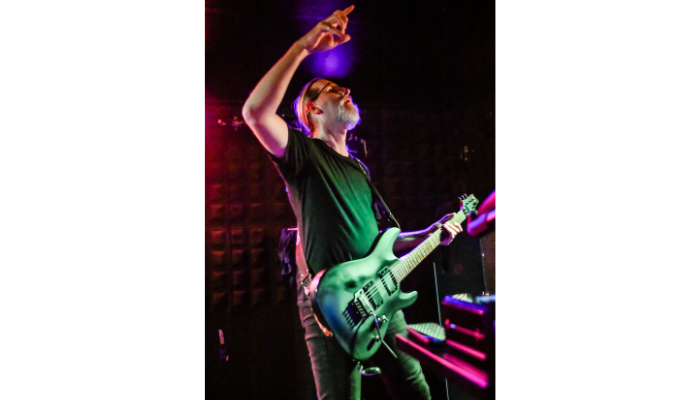
Steve Collins is known in the underground music scene by names like INfest8, Konqistador, Other, and z(cluster). Photo: supplied
“I’m an old goth,” Collins says.
“I love my ‘80s music, but I also really like industrial music. The band people might have heard of in that genre is Nine Inch Nails, but industrial music goes back to the ’70s and it has this political philosophy behind it, this drive to challenge authority.”
Listening to tracks like Everyday Is Halloween, The Rapture and Death Drive, it’s easy to hear that sentiment reverberating.
The sound is deliberately abrasive, textured and immersive. It’s built by grinding rhythms and fractured tones. There’s a sense of deconstruction at play: Collins doesn’t just compose music, he dismantles it - shaping sonic narratives that feel simultaneously chaotic and carefully engineered.
“I call it industrial, mainly because I use a lot of the harsh noises, but I also like melody,” Collins says.
“I have chronic migraine, and the grit in the audio is like a reflection of my vision. To some people, it might just sound like a lot of noise, but everything has a place and a role to play. And if people like it, then great. If they don't, it's going up on my SoundCloud anyway.”
Driven by a love of experimentation, Collins built a global fanbase of his music. In 2015 he produced a remix of singer Sara Noxx's release of Entre Quatre Yeux, which spent three weeks at number one on the German alternative charts.
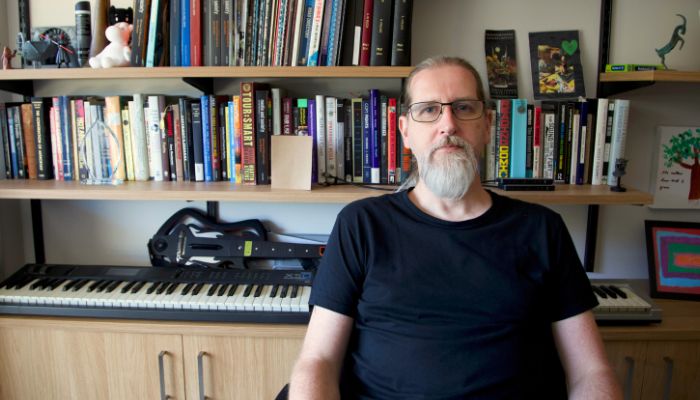
Steve Collins describes himself as an "old goth." Photo: Elaine Obran
Then, in 2018, he worked on Nafada with Konqistador, a politically charged industrial hip-hop project featuring female Arab and Muslim artists.
The album offered a platform for often unheard voices by sharing the lived experiences of women navigating life in the Middle East.
“In 2007, I started collaborating with this band called Konqistador,” Collins says.
“One of the members, Reg, had this idea to do an industrial hip-hop collaboration and started reaching out to artists across the Middle East.
“So, we created this album, and Sony was really interested. They saw it as an untapped space. But at the eleventh hour, they pulled the plug. They were worried about the political repercussions from some Middle Eastern governments.”
Despite the setback, the project found new life. Independent digital distributor The Orchard released the album, and while the corporate backing fell away, industry support didn’t disappear entirely.
“Sony still helped us behind the scenes,” Collins adds.
“They got us a homepage feature for Spotify users across the Middle East and North Africa.”
“As a creative project, it was very exciting, and it made me push the envelope on my appreciation of other genres as well.”
Back in his office, Collins’ dual worlds sit side by side comfortably. The academic and the creative are not two disparate identities, but two threads woven into the same fabric.
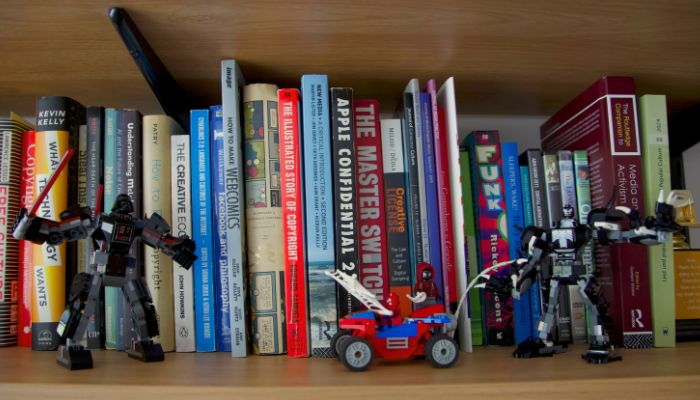
Collins’ dual worlds sit side by side comfortably. Photo: Elaine Obran
“My work and music do come together at points. A lot of my understanding of creative technologies and the music industry is an amalgam of my professional and personal interests and experiences.
“Some students have found their way to my music, but it's not something I actively promote.
“There are some points in my copyright law unit where I’ll show my Spotify royalty rates, but that is only as a teaching tool.”
Looking ahead to the future, that is the legacy he hopes to leave behind at Macquarie University. Not one measured by Spotify streams or stages, but in the quiet, lasting impact of those who pass through his classroom and beyond.
“I just really want to keep teaching and researching the things that I think are interesting and useful provocations for people to think about,” Collins reflects.
“I hope I'll leave an impression on students' lives and that it's a good one.
“That’s not just a ‘feed the ego thing’: seeing that they're using the skills and doing something that they are passionate about is the most important thing. Life's too short to work a job that you hate.”