
After more than two decades in research and six years leading a major research institute, Garry Myers is shifting focus.
Joining Macquarie University as a Professor in the School of Natural Sciences, and Lead for the Vaccine & RNA Design Centre (VRDC), he will build the systems, partnerships and pathways that allow RNA science to move beyond discovery and into real‑world use.
“Macquarie is good at the business of science,” said Garry, when asked about his move to Macquarie University.
“Most academics are researchers who think deeply – and that’s important. But what I want to do now is to help turn vaccine designs into actual viable vaccines that get into arms and animals.”
It is a characteristically direct answer from a scientist whose was instrumental in decoding bacterial genomes in the early 2000s, when sequencing a single organism genome cost around a million dollars. That work helped establish how microbes evolve, adapt and spread antibiotic resistance – papers that are still cited today and continue to underpin RNA research.

Professor Garry Myers, Faculty of Science and Engineering, Lead of Vaccine & RNA Design Centre at Macquarie University.
What RNA really is and why it’s misunderstood
Despite his new role, Myers explains his job with an understated, "I design vaccines. If someone wants more detail, I say I design RNA vaccines.”
RNA – ribonucleic acid – became a household acronym during the COVID‑19 pandemic, but Myers believes it is also one of the most misunderstood molecules in modern medicine. Popular among those misconceptions is that RNA vaccines introduce something foreign into the body.
“People say, ‘I don’t want to put an RNA molecule into my body,’ but every time you eat something, you’re eating DNA and RNA. Every time you swallow your own saliva, you’re swallowing millions to billions of bacteria that are actively making DNA and RNA,” Myers explains. “The history of vaccines is essentially a history of reducing the information delivered by a vaccine to only what is needed. RNA vaccines are the logical endpoint of presenting such minimal and memorable information to an immune system.”
A dilemma with RNA vaccines is about preserving the molecule long enough to be effective.
“RNA is inherently short-lived and degrades quickly. The idea that vaccine RNA persists in the body just doesn’t hold up,” Myers added. “It's not a molecule of information storage. DNA is a molecule of storage. RNA is a molecule of information transfer.”

Macquarie University's new RNA facility. Picture: Chris Barlow
Innovative assembly
Before RNA vaccines, most vaccines failed because they could not be produced economically. Scientists would spend decades trying to engineer proteins that could be manufactured reliably, folded correctly, and produced at scale.
Myers reaches for a historical analogy to describe how RNA changed that.
“Before Henry Ford, cars were made one at a time by craftsmen,” he says. “Ford introduced the assembly line and turned the manufacturing process into a black box. RNA has done something similar for vaccines.”
The RNA manufacturing process remains the same regardless of the disease being targeted; only the informational content of the molecule changes. This consistency in RNA vaccine production is what makes them so valuable.
“They're scalable, faster, cheaper, and you can iterate... If it doesn’t work, we can go back and redesign it and test again within days,” he adds.
Myers work sits at the start of the vaccine pipeline designing RNA vaccines and validating them to establish intellectual property.
Deciding which vaccines to design is therefore not just a scientific choice, but a strategic one. Myers weighs unmet medical need, commercial viability and the urgency of antimicrobial resistance.
This logic underpins HerdVax – a suite of RNA vaccines he is developing at Macquarie University to tackle livestock diseases traditionally treated with antibiotics.
“For decades, antibiotics have been used as a default solution in agriculture,” he says. “The problem is we’re breeding resistance. Those resistant bacteria can then move between animals and people.”
Myers argues vaccines offer a fundamentally different approach. Rather than attacking bacterial metabolism, vaccines can target how bacteria attach to cells, reducing pressure on microbes to evolve into antimicrobial resistant (AMR) organisms. This could reduce AMR infections in animals and people across the world.
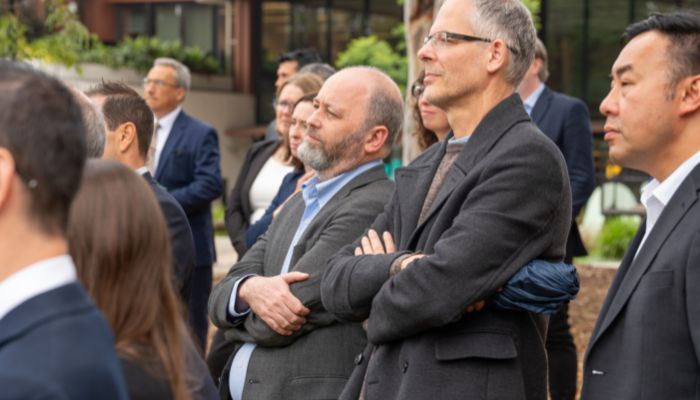
Garry at the opening for the RNA Facility on Macquarie Campus. Picture: Chris Barlow
Why Macquarie – and why now
Myers highlights Macquarie University’s focus on translation as a draw card for him. “At Macquarie, RNA is a university‑wide priority,” he shared.
The University’s investment in infrastructure, commercial engagement and industry partnerships signaled an understanding of how science moves from idea to impact.
“The business of science and science itself are different skill sets,” Myers says. “Macquarie recognises that and has built structures to support both.”
With incubators on campus, strong commercial engagement teams and a growing biotechnology ecosystem at Macquarie Park, he sees the University as well positioned to support the next phase of his work.
“I want to turn vaccine designs into viable products,” Myers says. “Macquarie has the ecosystem to do that.”
The RNA facility: completing the pipeline and preparing for what comes next
That translational ambition is underpinned by the new RNA research and pilot manufacturing facility on the Macquarie campus, which opened this week.
While Myers’ own work operates several steps upstream, the facility completes the pipeline.
“The facility is at the very end of the process,” Myers says. “When you want to scale up and deliver and put things in vials and have them on shelves.”
Within the Macquarie Park biotechnology ecosystem, design, validation, manufacturing and partnership come together to create something Australia previously lacked: a continuous RNA capability to produce our own RNA vaccines when required.
However, Myers is quick to balance out discussions on Australia's sovereign RNA capability.
“It depends on your definition of sovereign,” Myers says. “We now have a sovereign capability to produce RNA vaccines in New South Wales, and that’s important... [but] If the shipping shut down like it did in COVID, we still don’t make all the ingredients.”
What has changed, however, is readiness.
“If something like COVID hit again,” he says, “there would be a pretty straightforward path to manufacturing millions of doses locally, which in 2020 we did not have. That’s a big difference.”
Science with an endpoint
After decades in basic science, Myers is intentionally shifting toward translation.
“Most of my career has been in the basic space, now I’m trying to become a translational person,” he shared.
For him, papers and grant applications are not the destination but a waypoint, with the real goal being outcomes that move beyond the lab.
“I want to see what we do [at the Vaccine & RNA Design Centre] turn into a national outcome,” he says.
For Myers, and Macquarie University, the endpoint is no longer discovery alone, but delivery – science designed from the outset to move, scale and be ready when it is needed most.