
When Jessica Lewis, then a Master’s student at Macquarie University, volunteered to help save one of Australia’s most endangered frogs, she imagined her first day would involve, well, frogs.
Instead, it involved 500 bricks and a Toyota Camry.
Loaded into the back of Associate Professor Anthony Waddle's car, the bricks were supposed to be transported to Sydney Olympic Park, where they would become part of Waddle's research into frog saunas designed to protect the critically endangered green and golden bell frog. There was, however, one problem: the Camry wasn't designed to carry half a tonne of bricks.
It wasn't exactly the glamorous introduction to wildlife conservation Lewis might have imagined. But she came back the next day, despite the unloading it took to get the car moving – continuing to leap into every opportunity Waddle offered her.
Looking back, Waddle jokes he wasn't entirely convinced she would return, but it didn't take long for him to realise Lewis’s enthusiasm for frogs rivalled his own – a fascination that had taken root long before she ever stepped onto a field site.
"I was obsessed with reptiles," Lewis reflects.
"I got my first lizard when I was four, and every spring my mum and I would rescue tadpoles from little ponds we knew would dry up. We would raise them until they became frogs and then release them again.
"Later, I worked for a reptile breeder, which reignited that passion and made me realise I wanted to study zoology.
"I then came to Macquarie to complete a Master of Conservation Biology, and that's how my journey into frog conservation began."
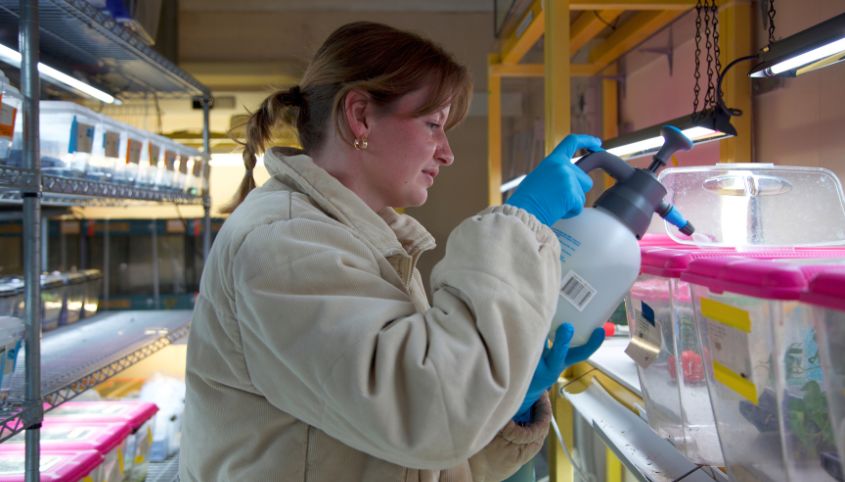
Jessica Lewi has always had a deep love for animals. Photo: Elaine Obran
But it wouldn’t be until Lewis reached out to researchers across the university who might need volunteers that she crossed paths with Waddle. And while the species at the centre of the project was small, the work they had to take on was anything but.
With the green and golden bell frog facing dramatic population declines due to habitat loss, introduced predators and chytrid fungus – a deadly disease that attacks amphibian skin and has devastated frog populations worldwide – the pair found themselves at the forefront of efforts to help save the species.
"The chytrid fungus doesn't affect all frogs the same, but in the green and golden bell frog, it has caused major population declines, and it attacks the skin," explains Lewis.
"The project we did back in 2024 when I first started volunteering with him was a pilot study. We brought frogs in from Sydney Olympic Park, treated them and released them, to show that it worked and didn't negatively affect the frogs – which it didn’t."
The success of that first trial laid the foundations for a much larger conservation effort.
Today, Lewis is helping monitor one of the team's largest breeding and release programs.
"We did this huge release program where we brought in a bunch of adult frogs from Sydney Olympic Park, bred them here at the university and raised all the babies.
"And then since then we've been doing post-release monitoring, where we capture them, swab and test their chytrid infection levels. It’s too early to speak on the data just yet, but the results so far are looking really good."
Inside the laboratory, the tiny, expressive faces behind this ambitious conservation effort bring home the significance of the work.
Rows of clear containers line the benches, each holding flashes of emerald green and gold. Some frogs are scarcely larger than a coin, their entire bodies fitting comfortably into the cup of Lewis's hand.
She carefully holds them, containing their back legs so they can’t jump away. The moment reflects the delicacy and determination it has taken to get the frogs to this point – with Lewis preparing food, cleaning enclosures and recording data, despite moments when she has asked herself, “How am I going to be able to do this?”
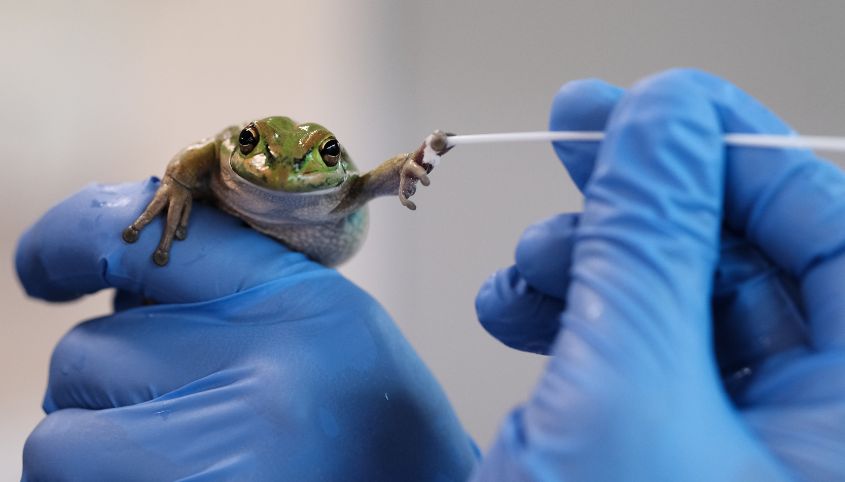
Today, Lewis is helping monitor one of the team's largest breeding and release programs. Image: Yorick Lambreghts
But it’s this work that has shaped her time at Macquarie University – learning from the research as much as she learns from the frogs themselves.
"One thing I've learned from these frogs is their resilience and adaptability.
"People will build beautiful ponds and habitats, and a frog, like the green and golden bell frog, chooses to live in the brick pit, which is an old, rundown industrial site turned conservation land.
"And they are not just surviving; they are thriving."
It’s a lesson Lewis has carried into her own journey.
Born in Canada, Lewis travelled across continents before moving to Australia, building a career in conservation while navigating the challenging conditions caring for the frogs requires.
It’s advice she now encourages other students to follow.
"Reach out to the animal research teams at the university and stick with the opportunities if they open up,” says Lewis.
"Not every day, especially working with animals, is glamorous – to be honest, most of my days are spent cleaning up poo.
"But I have found that by jumping on every opportunity Anthony’s offered me, I now have connections across Australia in conservation."
Of course, saying yes is only one part of what it takes to carve out a career in such a demanding industry.
Much like her first day volunteering, Lewis’s learning and knowledge has been shaped by the people who have helped her carry the weight of being a student.
For Lewis, that person was Associate Professor Anthony Waddle – a working relationship as symbiotic as the frogs they are helping to save.
"I have been extremely fortunate to find that in Anthony,” reflects Lewis.
“He's been an incredible mentor and supervisor, and someone who has given me the tools and stepping stones to get into the field.
“I’m like one of his biggest cheerleaders, but I also feel like he returns that to me and has really given me the confidence to enter this field.
"Sometimes, I ask myself, can I do this? But he believes in me, and that makes me feel like I can too."