
Jasmine Williams had just started mapping out her postgraduate research career in molecular biology at Macquarie University when fate tripped her up.
“Two weeks into my research Masters, I broke my ankle playing soccer,” says Jasmine, who’s a keen competitive player in Super League, leading the team’s defence as a centre back.
“The project I had planned to work on involved lots of standing at a lab bench, and that just wasn’t going to be feasible while I wore a ‘moonboot’ for five months.”
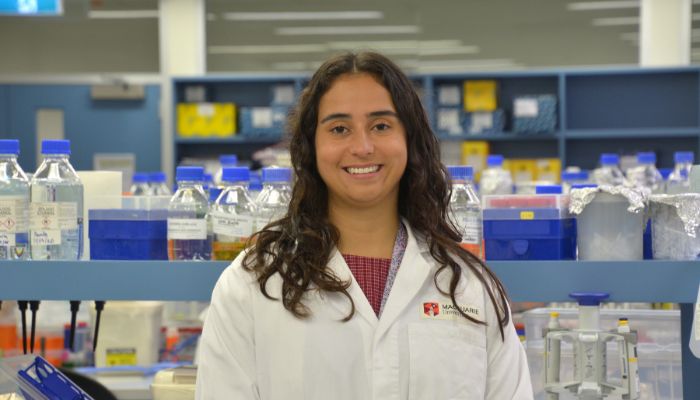
PhD candidate Jasmine Williams in the molecular biology lab at Macquarie.
Fortunately for Jasmine, another opportunity presented itself at just the right time in the laboratory of Professor Amy Cain, whose research focus is understanding the genetic mechanisms that underlie the worldwide problem of antibiotic resistance.
“The data from some incredible lab work on tuberculosis (TB) in partnership with Mahidol University in Thailand had just arrived, and I was offered the chance to work on the analysis for that project instead,” says Jasmine.
Fast forward three years and the findings from that lab work and Jasmine’s data analysis have just been published in the journal Microbial Genomics. The research represents a significant advance in understanding mechanisms of antibiotic resistance to the world’s deadliest disease.
For many people in wealthy Western countries, the mention of TB may evoke historic images of sanatoria and tragic Victorian literary figures. But for millions elsewhere in the world, it remains an urgent and very current reality: TB affects a quarter of the world’s population and is responsible for around 1.2 million deaths each year, making it the leading global cause of death from a single infectious agent.
Treating TB is unusually demanding. Standard treatment involves patients diligently taking a combination of antibiotics for a minimum of six months to eliminate the slow-growing Mycobacterium tuberculosis. Interruptions to antibiotic treatment and factors like limited access to healthcare can rapidly lead to resistant strains of bacteria emerging and becoming dominant, posing an enormous global public health threat.

Siriraj Hospital, Mahidol University, Bangkok, Thailand, where resistant TB was bred in the lab.
The Cain Lab at Macquarie has pioneered the use of “directed evolution”, in which disease-causing bacteria are allowed to evolve under carefully controlled conditions so genetic mechanisms underlying how antibiotic resistance develops and spreads can be studied in detail.
“By the time resistant strains are detected in the clinic, tuberculosis can have acquired multiple mutations for antibiotic resistance,” Jasmine explains. “But by growing bacteria in the lab under conditions that encourage the evolution of resistant strains, we can monitor and detect each of these mutations as they appear, allowing us to understand how each mutation helps tuberculosis gain resistance.”
The technique had never been applied to TB before.
“Directed evolution is easier with bacteria that grow very quickly, but M. tuberculosis grows much more slowly, so the process documented in our study took over a year for just one strain,” she says.
Co-researchers from Siriraj Hospital at Mahidol University in Bangkok effectively bred TB “superbugs” in a secure lab, exposing the bacteria to gradually increasing doses of the antibiotics rifampicin and linezolid – critically important first-line and last-line treatments respectively. At each step, only the bacteria that had evolved resistance survived to the next stage of the experiment.
“We sequenced the genome of the whole population of the bacteria at each step of their evolution so we could see which genetic mutations appeared when,” Jasmine says. “Some of those we found were already known from clinically resistant TB strains, but we also identified mutations in six genes not previously linked to rifampicin or linezolid resistance.”
“Surprisingly, on further investigation we found these antibiotic resistance genes aren’t only linked to TB, but they also confer antibiotic resistance in another critical antibiotic-resistant species – Escherichia coli – which is associated with an estimated 950,000 annual deaths worldwide.”
Jasmine and fellow researchers at Macquarie and in Thailand hope the outcomes of their study will help in the design of new treatment strategies to minimise the risk of antibiotic resistance and guide development of much-needed new drugs and drug combinations to treat TB.
Jasmine Williams is a PhD candidate in the School of Natural Sciences at Macquarie University.