
It’s not every day that you’re asked to perform CPR in front of your classmates, especially in a simulation environment that mimics an Intensive Care Unit.
While this might sound like a stressful scenario for many, for the students attending Macquarie University’s Girls to Graduates (G2G) STEMM camp it was an exhilarating glimpse of life in the medical profession.
Now in its second year, the G2G STEMM program is an initiative of the Access and Widening Participation (AWP) team in collaboration with the Faculty of Science and Engineering, and the Faculty of Medicine, Health and Human Sciences. The aim of the camp is to inspire the next generation of female innovators across science, technology, engineering, mathematics and medicine.
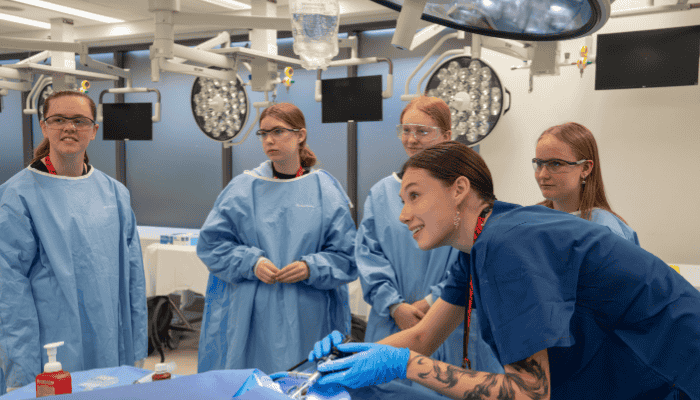
Students travelled from around NSW to attend the camp
High school students from around New South Wales take part in workshops, enjoy campus life and meet inspiring female researchers. This year, they learned about everything from robotics and website building through to wildlife forensics and animal trafficking.
The students also visited Macquarie University Hospital, part of Australia’s first fully integrated academic health precinct on a university campus
Krystal Johnson from Willyama High School was part of a cohort that travelled from Broken Hill to attend the camp.
“It really opened my eyes to the fact that university can be fun,” she says.
“On day one, we got to do CPR, and I found it was quite engaging. It wasn’t all work, it was more practical, hands-on things.”
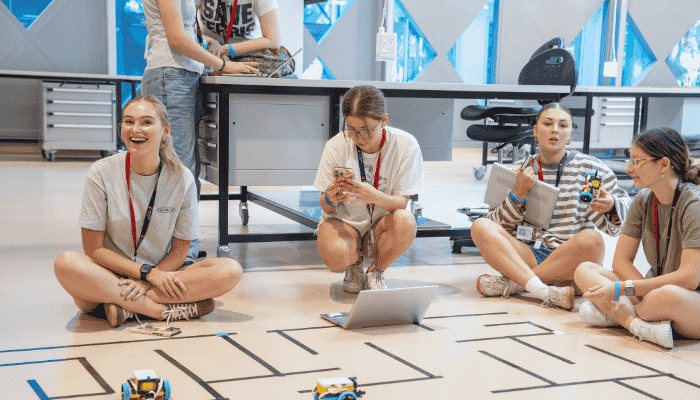
Students tried activities in all kinds of STEMM fields
Charlotte Turley from Broken Hill High School also loved learning more about the medical field.
“I’ve always had a passion for helping other people,” she says. “And being here has shown me lots of career paths and how I could pursue that in the future.”
That chance to see what life could be like after Year 12 was something Tamsyn Grillett from Broken Hill High loved about the three-day camp.
“The highlight of the program, I would say personally, would be the sports science,” she says.
“The fields that most excite me are the sport related fields like health and medicine, and I really hope to pursue that in the future.”
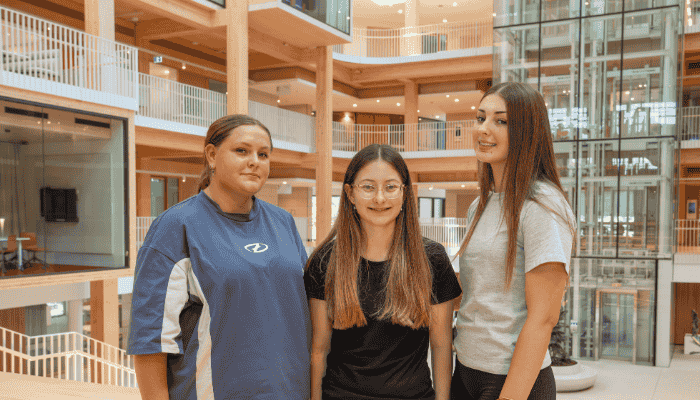
Broken Hill students Krystal Johnson, Tamsyn Grillett and Charlotte Turley attended the 2026 camp.
Research cited by the Government’s STEM Equity Monitor shows that the level of confidence girls feel in studying STEM subjects decreases over the course of their teen years. Girls are also less likely than boys to choose STEMM subjects as electives in Year 11 and 12.
Meeting women with success in these fields can be a powerful way to shift the narrative. After all, as the adage goes, you can’t be what you can’t see.
That’s why the camp organisers invited STEMM based industry partners to spend time with the students.
“Our industry partners are a critical part of this program because they show young women what is actually possible, and how diverse STEMM careers can be,” Pro Vice-Chancellor (Education) Professor Taryn Jones says.
“They also give real credibility because they are the potential employers of our graduates.
“We are very grateful to all the organisations that supported this camp, with a special thanks to Astra Zeneca and Qantas for providing sponsorship of the camp, further highlighting how important industry partners view the building of a strong pipeline of women into STEMM careers.”
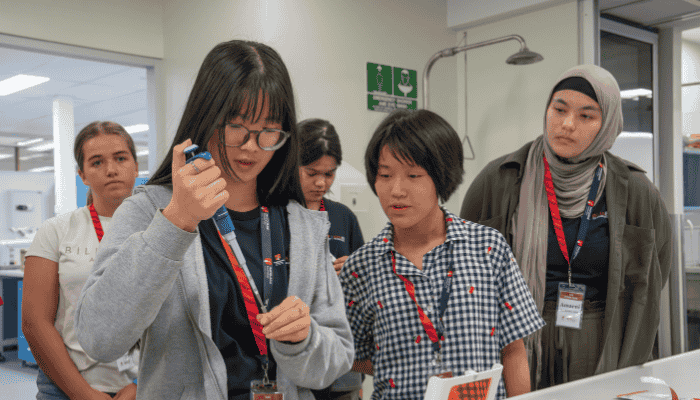
Girls are less likely to choose STEMM subjects in Year 11 and 12, data shows.
Dr Paige Erpf from the ARC Centre of Excellence in Synthetic Biology was one of the panellists in a session celebrating Superstars of STEM.
Her own love of science was first sparked when she learned about Dolly the sheep, the first ever mammal cloned from an adult somatic cell.
“The best part about being a woman in STEM is I get to showcase to other young women that I am a scientist, I get to do pretty cool stuff, and I absolutely love doing it,” she says.
Marine wildlife researcher Dr Vanessa Pirotta also took part in the panel. Initiatives like the G2G STEMM camp weren’t around when she was in high school, she says. Nor was there any discussion about being a woman in science.
“We are wanting to change that now,” she says. “We’re trying to change the narrative, so when someone draws a scientist, they don’t draw a gentleman in a lab coat.”
Representation is increasing, says palaeontologist and fellow panellist Sally Hurst, but progress is slow. She’d love to see more women in leadership roles especially.
“We need the young people to come in and get in these positions as well,” she says.
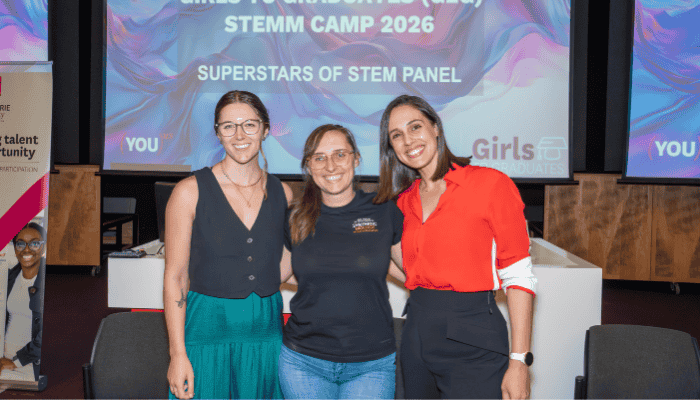
Sally Hurst, Dr Paige Erpf and Dr Vanessa Pirotta
When asked what they’d tell young women with an interest in STEMM fields, the Superstars of STEM panellists have some advice.
“Know that there’s only you and no one else is like you,” says Pirotta. “Use your passion, your enthusiasm, whatever interests you to help drive you forward.”
“Unapologetically be yourself,” Erpf agrees. “The more that I am myself the more people appreciate me - and it has opened up a lot of opportunities. Don’t hide, say yes, and just be true to who you are.”
“Go for it,” Hurst adds. “Just say yes and see where those opportunities take you. I was offered a chance to do a gig about my research at Sydney Comedy Festival. I was invited to the National History Museum to do a talk. I never would have imagined these things were possible.”