
The founding director of the Australian Institute of Health Innovation (AIHI) at Macquarie University, Professor Jeffrey Braithwaite, wants healthcare professionals to keep these three numbers in mind – 60/30/10.
“These are the topline numbers we should be looking at when it comes to healthcare and patient safety,” says Professor Braithwaite.
“Sixty per cent of care on average is in line with evidence-based guidelines; 30 per cent is waste and inefficiency and 10 per cent harm.
This paves the way for Safety-II or as Professor Braithwaite likes to call it - “the study into when things go right to keep patients safe”.
Wait, isn’t there a Safety-I? Back to those thoughts in a moment.

The founding director of the Australian Institute of Health Innovation (AIHI) at Macquarie University, Professor Jeffrey Braithwaite.
The pathway to improving resilient healthcare systems
Having trained in psychology, then working in HR as a general manager in healthcare across 15 years, and then as a researcher for over 25 years, Braithwaite’s dedication to health systems has been driven by a couple of things.
Making a scholarly contribution is one of them.
“I’m reminded of Hippocrates’ teachings and the influence it’s had on my work as a health systems researcher. If we make a habit of two things: to help humanity, or at least do no harm,” shares the scholar who, after a career in the health system, left to focus on further study – a Doctor of Philosophy.
The other, is his purpose – to deliver good care to patients – always asking the question: “how do we keep striving for the best possible healthcare for patients in Australia—and beyond?”
“You could say that becoming an academic and teaching is what led to my purpose.
“The other was building something sustainable in AIHI, advancing health services research with a talented team of researchers; and creating something meaningful that people could believe in and support.”
AIHI is a world-renowned research institute dedicated to transforming healthcare services, systems and policy in Australia and around the globe. Based at Macquarie University Health — Australia’s first fully integrated academic health sciences centre — and spanning both the Faculty of Medicine, Health and Human Sciences and Macquarie Business School, AIHI brings together the country’s largest concentration of specialist health services researchers.
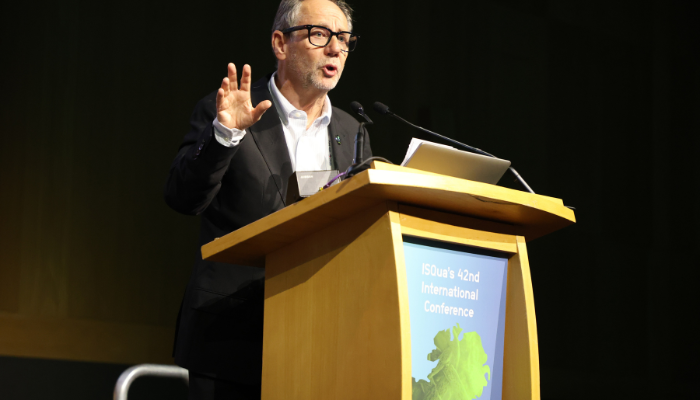
Professor Braithwaite speaking at ISQua’s 42nd International Conference held in Dublin in September 2026.
“Australia has one of the best health systems in the world, consistently ranking at the top five or 10 health systems out of 195 countries in the world,” says Braithwaite.
“I’m proud to be leading a team of dedicated researchers who are delivering research outcomes ranging from implementation science in genomics and cancer care, to digital health and patient safety research that strengthen healthcare quality.
“The team at AIHI was recently awarded an Avant Foundation Research grant, which will support safety analysts to identify emerging risks and help reduce patient harm,” says Braithwaite.
A pivotal moment for Professor Braithwaite was joining the board of the International Society for Quality Health Care (ISQua). Professor Braithwaite was president for three years and on ISQua’s Board for over 11. The organisation brings together healthcare leaders with decades of expertise spanning clinical leadership, health systems research, policy development and patient safety advocacy. Every member of the board contributes a unique viewpoint, informed by work across diverse countries, disciplines and care environments.
Back to the burning question of Safety-I vs Safety-II
During his time as a HR practitioner and general manager in hospitals and local health districts, Professor Braithwaite noticed most healthcare models operated on a Safety-I approach.
Put simply, it’s a model that identifies when things go wrong. A find and fix model, where staff look at policies, procedures, the adverse events and then find ways to reduce errors to zero to keep staff and patients safe.
Resilient healthcare is much more than that.
His six edited books and many studies into what goes right reveals that a shift from a Safety-I to Safety-II approach is necessary.
“Safety-II looks at why things go right to keep patients safe. This is critical in looking at ways to improve and help shape a better healthcare system. And it’s one that puts the patient at the heart of our research.
“If we think about it terms of studying shark behaviour, we could say that Safety-I asks: ‘Why did the shark bite happen?’ Safety-II asks: ‘Why do shark bites almost never happen despite millions of people swimming in the ocean?’
“It’s a concerted effort to enable things to go right more often,” explains Professor Braithwaite.
The researcher and founding director reflects on his time working in a hospital and his observations of what happens in wards and intensive care units.
“Wards in hospitals are busy, there are nurses looking after challenging patients – it’s sometimes calm, something seemingly chaotic, but mostly busy,” he says.
“As soon as a patient goes into a ward, they’re vulnerable and in need of help. Some patients inevitably deteriorate while in the ward. What needs to happen is to notice the deterioration of a patient before they crash,” explains Professor Braithwaite.
“Noticing that, and calling the medical emergency team from the Intensive Care Unit is quite a skill – and we did lots of research on this. It’s a Safety-II approach – making sure patients come to no harm.”
“Instead of looking at how the system will cope when it’s under stress, the Safety-II approach studies why things are going right in the system and how healthcare professionals can implement more of that to improve safety for patients.”
At its heart, proactive safety management focuses on how everyday performance usually succeeds rather than on why it occasionally fails, and actively strives to improve the former rather than simply preventing the latter.
Recognising a lifetime commitment
On November 9, Professor Braithwaite was the first Australian scientist to be awarded an Honorary Doctorate from Erasmus University Rotterdam.
Erasmus University Rotterdam is honouring a scientist who is an international leader in the field of healthcare systems. His pioneering research into patient quality, patient safety, resilience and sustainable system change has not only led to important scientific insights, but it has also had a global impact on healthcare policy, governance and practice.
Professor Maarten J. IJzerman, PhD Dean, Erasmus School of Health Policy & Management, Erasmus University