
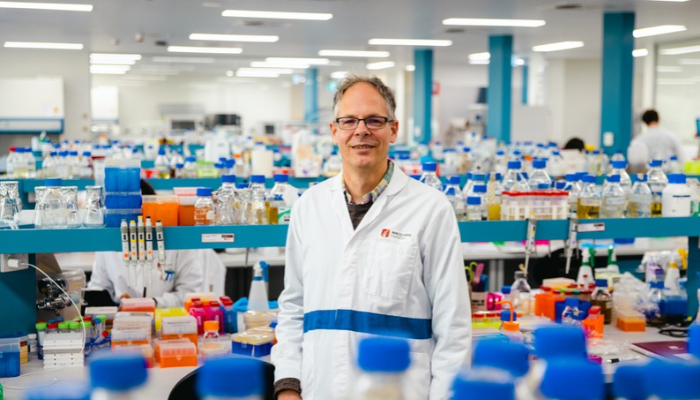
Distinguished Professor Paulsen is Director of the Australian Research Council (ARC) Centre of Excellence in Synthetic Biology and the Australian Genome Foundry. The ARC Centre of Excellence has helped support the creation of 13 start-up companies, which have collectively attracted more than $230 million in venture capital, demonstrating how fundamental scientific discoveries can generate economic and environmental benefits.
Supplied
Synthetic biology is considered to have transformational potential on par with artificial intelligence and quantum computing, opening new frontiers in science and transforming how we make things.
Professor Paulsen and his team have harnessed the capabilities of living systems to design, build and optimise biological processes for practical applications. This means researchers can engineer microorganisms to act as microscopic manufacturing platforms: turning agricultural waste into fuels and valuable chemicals, producing sustainable alternatives to fossil-fuel-derived plastics and textiles, manufacturing medicines and food ingredients, and helping break down environmental pollutants. The possibilities extend across industries, from agriculture and energy to healthcare and manufacturing.
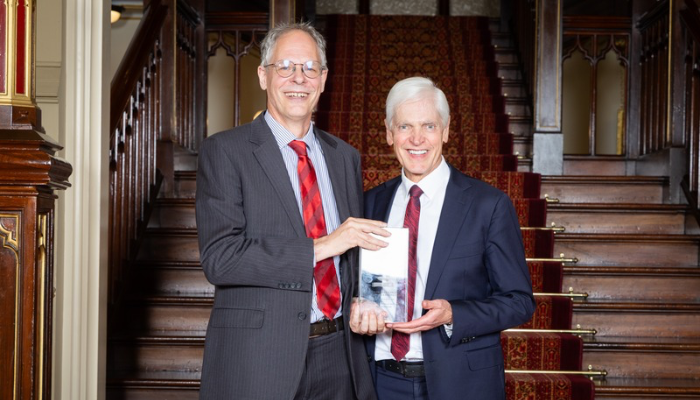
His contribution to the field has been recognised with the state's highest scientific honour, awarded at the NSW Premier's Prizes for Science and Engineering.
Reflecting on the award, Professor Paulsen said: "I'm enormously honoured to receive this award, but it also reflects the extraordinary work of the researchers, students and industry partners who have helped build synthetic biology in Australia."
His recognition follows a distinguished career spanning microbial genomics, antibiotic resistance and synthetic biology. It is this combination of scientific leadership, collaboration and a commitment to developing Australia's research capabilities that has helped establish Macquarie as a major contributor to the field.
Macquarie University Vice-Chancellor Professor S Bruce Dowton said Professor Paulsen's achievements demonstrated the University's commitment to research with real-world impact.
"Ian is an exceptional scientist whose vision and leadership have helped establish Australia as a global force in synthetic biology.
"His work shows how fundamental scientific discovery can lead to new industries, create economic opportunities and help address some of the world's most pressing challenges.
"We are immensely proud to see Ian's contribution recognised with the state's highest scientific honour."
From scientific discovery to real-world impact
One of the defining achievements of Professor Paulsen's career has been his contribution to the international Yeast 2.0 project, an ambitious effort to design and build the first synthetic genome of a eukaryotic organism.
Working with international collaborators, his team helped synthesise an entire yeast chromosome, contributing to a project that is pushing the boundaries of what scientists can achieve in genome engineering.
Unlike simply sequencing an organism's DNA, synthetic genomics involves designing genetic material and physically constructing it, then testing how it functions inside a living cell. The work is providing fundamental insights into how genomes operate and how they might be redesigned for new purposes.
Supplied: Macquarie University
Another significant achievement of Professor Paulsen's career has been helping build Australia's synthetic biology ecosystem. The ARC Centre of Excellence has helped support the creation of 13 start-up companies, which have collectively attracted more than $230 million in venture capital, demonstrating how fundamental scientific discoveries can generate economic and environmental benefits.
Among them are Number 8 Bio, which is developing livestock feed supplements to reduce methane emissions; Entozyme, which is engineering insects to transform organic waste into valuable products; Newera Bio, which is developing bio-based dyes and pigments; and Levur, which is engineering yeast to produce sustainable cosmetics and oils. All four companies emerged from Macquarie research.
As the world looks for new ways to address climate change, resource scarcity, food security and the transition away from fossil fuels, synthetic biology is emerging as an important part of the solution. For Professor Paulsen, the recognition is not simply a celebration of what has already been achieved, but an acknowledgement of the possibilities still ahead.