
Interventional pulmonologists Professors Alvin Ing, Tajalli Saghaie and Jonathan Williamson have a strong track record of clinical innovation in the use of robotic bronchoscopy for diagnosing lung cancer.
Beginning in 2022, they led first-in-human trials of second-generation robotic bronchoscopy technology that allowed them to locate and take diagnostic biopsies from small, hard‑to-reach nodules in the farthest reaches of the lungs.
Lung cancer killed an estimated 9000 Australians in 2025 and is the world’s leading cause of cancer‑related deaths. Its high mortality rate is mostly attributable to the fact that, by the time someone with lung cancer experiences symptoms, the disease is typically well advanced, so speed is of the essence.
“We know the single most important factor in survival from lung cancer is its stage when diagnosed, so earlier diagnosis and more rapid treatment have the potential to reduce mortality significantly,” said Professor Saghaie.
Efficient clinical pathways
On the back of their successful clinical development work, they then established both a specialised pulmonary nodule clinic and the Early Lung Cancer Detection (ELUCiD) program at Macquarie University Hospital, with the aim of creating even faster and more efficient pathways for diagnosis, assessment and management.
Now, using a newly installed Ion robotic bronchoscopy platform developed by medical technology company Intuitive, the team are exploring the use of bronchoscopic interventions in high-precision treatment of lung cancer.
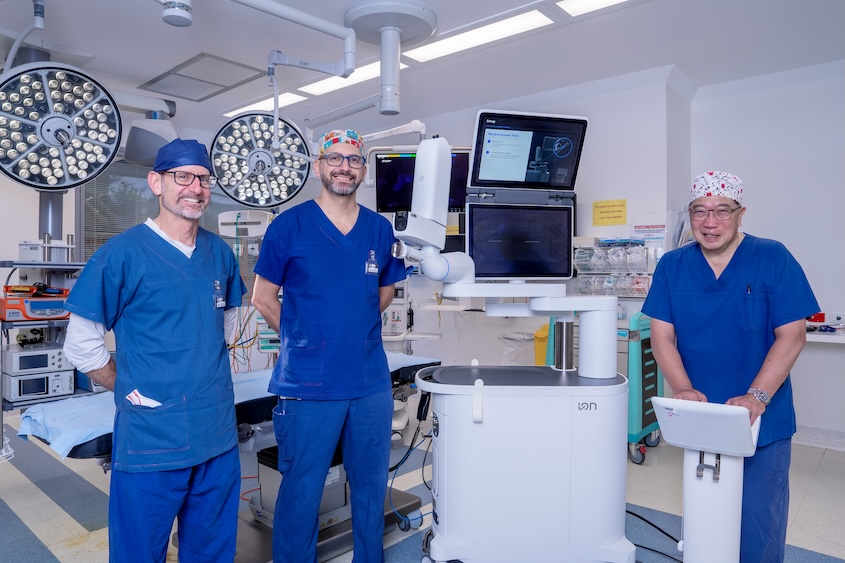 Macquarie interventional pulmonologists Professors Jonathan Williamson, Tajalli Saghaie and Alvin Ing with newly-installed Ion robotic bronchoscopy equipment
The pulmonologists are increasingly using robotic bronchoscopy to place fluorescent coils into lung nodules to help localise them for precise surgical removal using minimally invasive technology like the state-of-the-art da Vinci surgical robots. This can be especially useful when nodules are small or less dense – so-called “ground glass” lesions due to their hazy appearance on X-ray images – or when their edges are poorly defined.
Professor Saghaie is also leading the CONVERGE study, a clinical trial in patients with Stage III non-small cell lung cancer, in which robotic bronchoscopy is used to inject nanoparticles containing the heavy metal hafnium directly into the tumour with the aim of amplifying the local effects of radiation therapy.
Lab to support innovation and training
The newly launched Macquarie University Bronchoscopy Research and Innovation Lab – or MQ BRIL – will focus on providing and developing high-fidelity models recreating human airways and lungs to support research, exploration and training.
“Our vision is for MQ BRIL to be an independent translational research laboratory where new bronchoscopic technologies can be evaluated, refined and compared,” said Professor Saghaie.
Macquarie also aspires to become an Asia-Pacific regional training centre for interventional pulmonology and bronchoscopy, with the support of industry partners like Intuitive, which also makes the da Vinci surgical robots, and their Australian distributor Device Technologies.
“We’re building a collaborative platform where clinicians, engineers, researchers and industry can work together to develop and evaluate next-generation technologies for diagnosing and treating early lung cancer,” said Professor Saghaie.
To learn more about the Macquarie University Health Respiratory and Sleep Clinic and its interventional pulmonology services, visit the website.