
Communications Minister Anika Wells declared a “reckoning” for US tech titans as the government revealed platforms would be subject to $100 million fines under a proposed Digital Duty of Care.
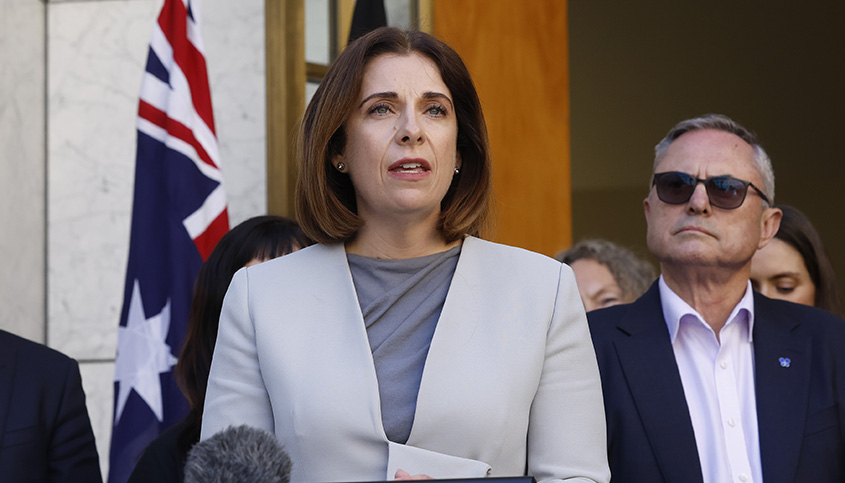 Anika Wells and Anthony Albanese hold a press conference in Canberra. Photo: Getty.
In the draft legislation announced on Tuesday, Labor outlines five key harms to children that companies should prevent under 16s from seeing online: pornography, promoting disordered eating, encouraging “hostile attitudes towards women or gender equality”, glorifying crime or dangerous stunts, and bullying or harassment. Platforms will also be required to remove addictive design features “that have negative behavioural impacts” for young people.
The reforms will also capture online games, apps, and AI chatbots, with new powers given to the eSafety commissioner and researchers to investigate compliance.
The “My Feed, My Way” initiative will compel Facebook, Instagram and TikTok to send notifications to new and existing users of all ages — offering them a feed filled only with accounts they follow. For those old enough to remember, this option will essentially revert your social media feed to how it was pre-2016.
Algorithms have been criticised for amplifying sensationalist content, reinforcing echo chambers and playing a role in radicalising young people in the interests of keeping people on platforms for longer.
Prime Minister Anthony Albanese is expected to spruik the plan at the United Nations general assembly in New York later this month. “We’ve started a global movement,” Albanese said. “It’s about putting choice back into the hands of Australians online… and it will hold the big tech companies responsible for inaction.”
Opposition leader Angus Taylor and One Nation leader Pauline Hanson will not support the bill on the grounds of “censorship.” Given their opposition, any new legislation would require support from the Greens to pass the Senate. The Greens have called for stronger opt-in rules, like those supported by Teach Us Consent campaigner Chantel Contos. That model would require social media users to give explicit consent to platforms before being subject to algorithmic content.
So, does the Digital Duty of Care have the teeth to take on Big Tech? Four out of five experts said yes.
 Australian adults will be able to choose whether they want an algorithm-driven social media feed under the “My Feed, My Way" initiative. Photo: Getty.
Dr Mark Williams is an internationally recognised Australian cognitive neuroscientist, with over 25 years of experience in brain research. He is an Honorary Professor, Macquarie University School of Psychological Sciences.
MARK: The Albanese Government’s Digital Duty of Care legislation is a welcome and long‑overdue correction to a system that has allowed tech companies to make billions while manipulating our attention, shaping our behaviour and harming our mental and physical health. For years, these platforms have engineered addictive features that keep children and adults online longer than they intend, often at the expense of sleep, wellbeing and real‑world connection. This legislation finally acknowledges that the design of these products, not the users, is the problem.
The My Feed, My Way initiative is a meaningful step toward restoring autonomy. Allowing Australians to opt out of algorithmic feeds is not about restricting choice; it’s about reclaiming it. Algorithms have quietly dictated what we see and how we feel for too long.
Extending the Duty of Care to games, apps and AI systems is equally important. Neuroscience has shown repeatedly that developing brains are highly susceptible to high‑stimulation digital environments, yet tech companies have faced almost no consequences for exploiting this vulnerability.
The fines attached to the legislation, while symbolically significant, are far too small for companies whose annual revenues dwarf national budgets. If we truly want accountability, penalties must be large enough to change behaviour, not simply absorbed as a cost of doing business.
Dr Danielle Einstein is a clinical psychologist and researcher whose work examines the links between technology use, school programs, and anxiety in young people. She is an Adjunct Fellow at Macquarie University.
DANIELLE: I welcome the Australian Government’s recognition that online harm is not caused by algorithms alone. The proposed duty of care would require digital services, including online games, apps and AI chatbots, to protect under-18s from design features that can produce addictive behaviour or damage self-esteem.
This is an important shift away from expecting young people and families to manage these risks by themselves. Awareness alone is not enough. Young people may recognise persuasive design while continuing to scroll. They may identify misinformation in a classroom activity yet still engage with emotionally compelling content later that evening. They may understand that anonymous posting can enable cruelty and remove accountability, yet still create a second account and post things they would never say under their own name.
However, limiting addictive and self-worth based design protections to under-18s remains concerning, because young adults are vulnerable to many of the same traps. I would also like to see visible engagement metrics removed so Australians are not encouraged to trade in outrage or base their self-worth on daily changes in the size of their online audience. New features should be independently audited before release, and accountability should extend to the executives who approve harmful designs, rather than resting solely with the corporate entity after damage appears in our clinics.
Professor Dali Kaafar is Executive Director of the Cyber Security Hub, School of Computing and CEO of Apate.AI.
DALI: My honest view is that the intention is right, but as it stands this will not change much, because an opt-out is the weakest version of a good idea. Here is the problem: The algorithm is not a setting you switch off once and forget. It is constantly learning you, from every tap, pause and scroll, and adjusting what it shows you to keep you watching. An opt-out is a one-off switch against a system that never stops adapting. Turn it off, or simply keep using the app, and it quietly rebuilds its picture of you. And even with the recommended feed turned off, the platform is still collecting your data and profiling you.
You can opt out of the feed. You cannot opt out of being profiled. So a toggle most people will never find is not a real control. If the government wants this to work, two things matter far more than the opt-out button. Make the safer setting the default, rather than something you have to hunt for. And put limits on what these systems are allowed to chase in the first place, which today is simply your attention, for as long as they can hold it.
Dr Wayne Warburton is a Professor of Developmental Psychology and registered psychologist at Macquarie University.
WAYNE: The Digital Duty of Care bill proposed by the Australian Government aims to provide a range of protections to children, including from the addictive design aspects of online products such as social media platforms, online games and AI chatbots. For me, such changes cannot come too soon. I have seen firsthand the sometimes devastating effects of digital addictions on mental health, physical health, school/work, relationships and the ability to negotiate the offline world.
Whilst such effects have been well known to clinicians working in this field for years, big tech have been reluctant to acknowledge such problems, or to make the sorts of changes needed to address them. Recent court cases, however, have forced them to take this issue seriously. A March finding in a Los Angeles court found that the addictive design of platforms run by Meta and Google had contributed to the plaintiff’s mental ill health, and in August Meta agreed to a historic multi-billion dollar settlement with many US States to resolve claims that it designed addictive social media platforms that harmed young users. Such lawsuits (and whistleblowers) have also made public internal research from big tech companies demonstrating that they knew about harms from their digital products, and were aware of their addictive features.
This proposed legislation will protect Australians, especially those most vulnerable to digital harms, and has the benefit of applying to all like platforms, thus not singling one out to have a competitive disadvantage. Because it is at the cutting edge though, it is also likely to have some teething problems. There are so many elements to addictive design, there may be issues with compiling a sufficient list of design features to address, and tech companies may claim there will be technical difficulties resolving some. Given existing compliance issues around the social media age change, compliance is also likely to also be an issue should the proposed legislation become law. This means that tweaks to the laws and their oversight will need to be made along the way, and that full benefits may come down the track rather than straight away.
My message to the government is: stay the course. This needs to happen. If there are teething issues, ignore the inevitable claims that this isn’t working, or cannot work and should be abandoned. This is about a long game, but one that eventually will benefit many Australians.
Deborah Youdell is an internationally renowned Professor of Education and Dean of Macquarie School of Education.
DEBORAH: I remember back when I lost control of Facebook. It started feeding me all sorts of things I didn’t want to see. I had to hunt among Facebook’s feed to find my friends’ posts. One friend told me how she had influenced the algorithm by liking wildflowers and woodworking. But I didn’t understand why I couldn’t just turn the algorithm off. In the lead up to the social media ban the Government was presented with the competing pull of evidence showing the harms caused by social media; forms of community and connection on social media that are protective for young people; evidence from their own curriculum authority (ACARA) that social media is a key source of young people’s political information and; that social media is, potentially, a democratic freedom to which young people have a legal right.
The proposed Digital Duty of Care begins to fulfil the calls made in advance of the ban to regulate the platforms and require them to provide a safe product, rather than simply restricting young people’s access. We know that social media is embedded in the everyday lives of many young people as well as adult.The claim that a Digital Duty of Care is Government censorship is dog-whistle politics. The proposed legislation is returning choice and control to users and consumer. It re-opens the possibility that the World Wide Web could be a safe vehicle for dialogue and democratic participation, for young people and adults alike, just as early coders and users hoped it would be.