
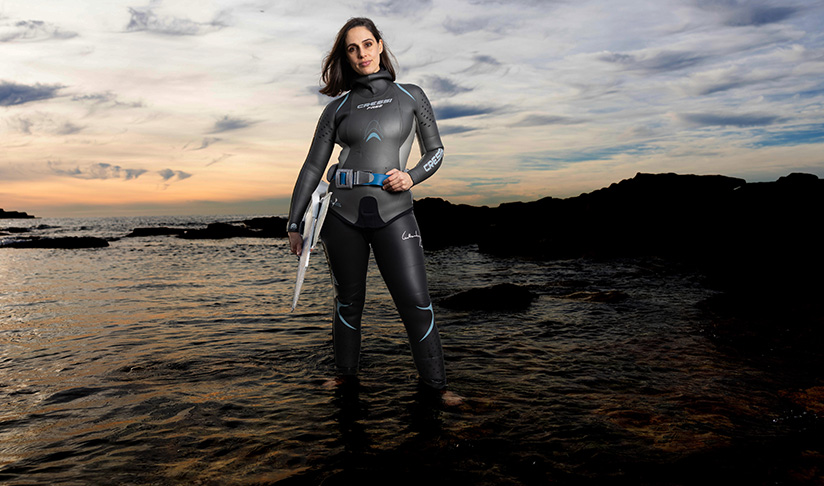
 Wildlife Scientist, Dr Vanessa Pirotta. Photo: Don Arnold.
The wildlife scientist has just returned from Tonga where she was training local ‘ocean ambassadors’ to monitor whale sightings and collect environmental DNA, a tool used to detect marine life. The work aims to ensure the sustainability and longevity of whale swim tourism in Tonga.
“It was the first Tongan-led whale research ever, which was conducted on a community vessel,” Dr Pirotta says proudly of the collaboration with the local Vava’u Environmental Protection Association (VEPA).
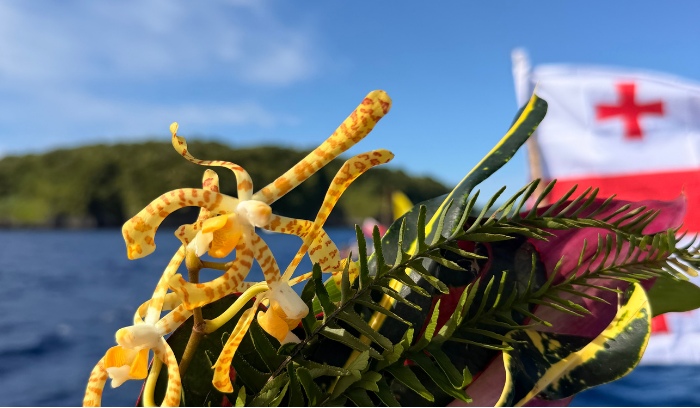
Tonga, 2026. Photo: Vanessa Pirotta.
The trip was a pivotal moment in her career. “As a scientist I love not only learning about the animals I study but working with people who also love nature, to empower and upskill them to protect the creatures we all collectively share and love.”
For some of the local team and new ambassadors, it was their first time seeing a whale in the wild.
“I had the hydrophone in the water, and we could hear the whales, and I played that to some of them. All of this was recorded on film and was probably the most special video of my life. The gusto and the willingness to learn was just so wonderful.”
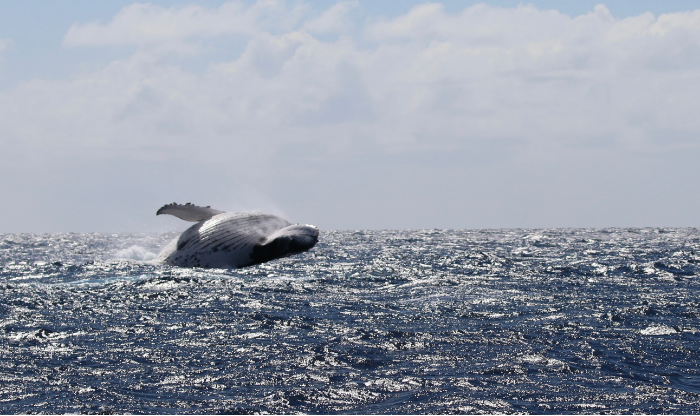
A whale sighting in Tonga, 2026. Photo: Vanessa Pirotta.
It’s Dr Pirotta’s fifth trip to Tonga since 2013, following in the footsteps of her PhD supervisor Professor Rob Harcourt from Macquarie University.
Accompanying her this time were Gamay Rangers Bryce Liddell and April Allende, who Dr Pirotta first began working with while writing her book The Humpback Highway.
“I've had the opportunity of learning from the Gamay Rangers, but also to open their eyes to a different perspective. It's an extension of Sea Country care for them because we directly share whales [with Tonga], whales do not have international passports, they swim where like, when they like.”
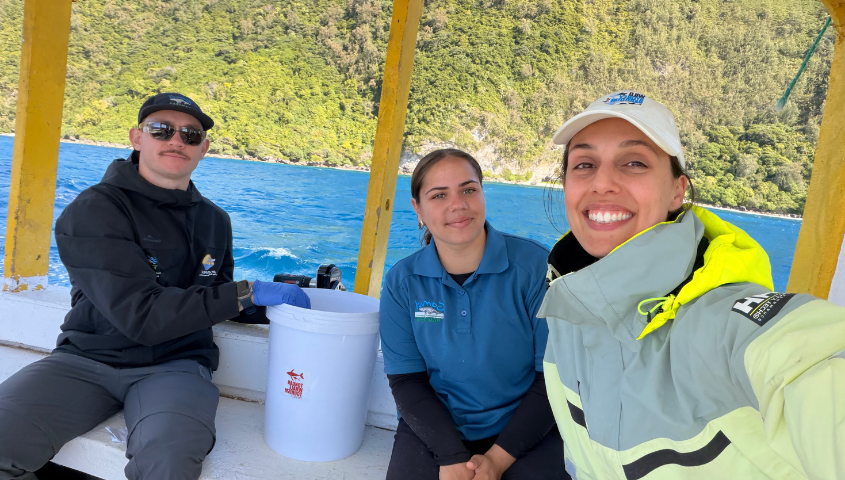
Vanessa Pirotta with Gamay Rangers, Bryce Liddell and April Allende, in Tonga 2026. Photo: Vanessa Pirotta.
In Tonga, the trio swam together with whales, found a pod of spinner dolphins while collecting acoustics and DNA and heard the Tongan Whistler’ - a rare bird found only in Vava’u. This journey also created connections with Tongan locals and opportunities to share indigenous knowledge.
“You've got two people who are the next generation in the community, who have the opportunity to be exposed to these things, and who I'm fortunate enough to be working with. It's the most empowering thing.”
Whale song
Dr Pirotta was always going to work with sea mammals – an obsession that began on the farm she grew up on in Canberra.
“As a little girl, all I wanted was to be a dolphin trainer. Mum bought me Free Willy on tape when we lived on the farm. I had the Free Willy Barbie doll with the killer whale. It was all I wanted to do.”
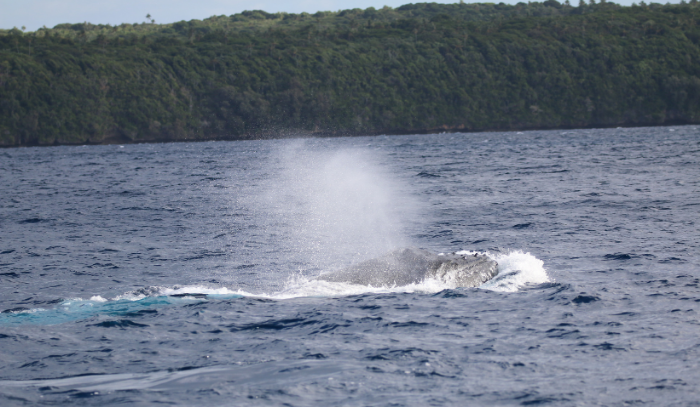
A whale sighting in Tonga, 2026. Photo: Vanessa Pirotta.
After leaving high school, she did a gap year in England at St. George's School in Windsor as a teacher's aide, before being accepted into ANU (Australian National University) where she studied Zoology and evolution and ecology and volunteered in the laboratories.
Her childhood dreams then came true when she was offered a job as a dolphin trainer in Coffs Harbour – her first experience as a science communicator.
“When I was giving marine mammal presentations, I remember thinking ‘there is grandchildren and 100-year-olds in the audience - how can I make the information relatable to all of them?’”
Then Dr Pirotta, at 22, received devastating news from home. “My mum died suddenly of an aneurysm at age 52 and my whole life changed. She was so young.”
To be close to her dad, Dr Pirotta took a job in the Federal Government in Canberra, working in marine compliance. But the experience of losing her Mum transformed her - she wanted to make a lasting impact to through her science.
“So, I started harassing Rob Harcourt. I emailed him and said, ‘what can I do now?’ I felt like I had more to give. Every month, he said, ‘something will come up’.”
And it did. Dr Pirotta was invited to be a research assistant on a project trying to prevent whale entanglement. This led to her Masters and then PhD investigating threats to cetaceans.
Her mother’s death had unlocked a new passion. “I look back on it, and yes, it was a really shit time, but I've also grown so much from it. I have that gusto to do things because I know life is too short…I could have been a dolphin trainer forever, and I'd still be doing the same thing to this day, 15 years on.”
Spreading the word
Since then, Dr Pirotta has become a well-known science communicator, a regular in local and international media and an active social media presence – recently hitting a million views on a post about a whale birth.
“It was through my PhD where I started talking about my research because people wanted to know about what I was doing with drones and whale snot. It wasn't that I was going out to be what is now known as a science communicator.”
It’s undoubtably one of her strongest talents – with Dr Pirotta appearing regularly on prime-time Australia television and radio and international media – as well as social media.
“It's sharing knowledge, helping people understand so they're informed. That's why I love it. If people are informed, they can make good decisions.”
But she’s clear, practising science remains her focus – including the recent development of a world-first AI algorithm, capable of detecting marine wildlife being smuggled through airports, using 3D X-ray scans. “I'm very much active in publishing research. I work very hard to produce science and I do that whilst having children as well.”
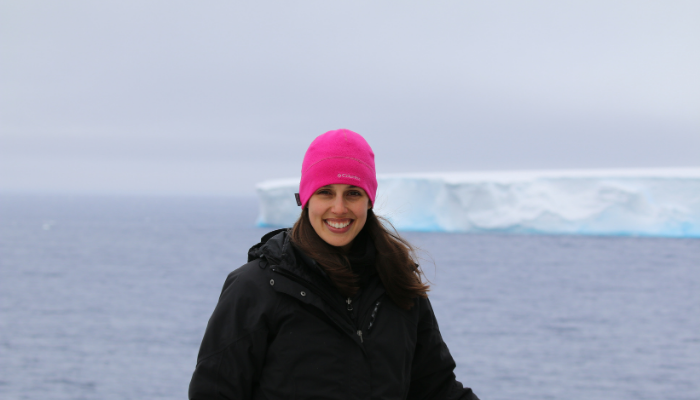
Vanessa Pirotta in Antartica. Photo: Supplied.
The mum of two – Hugo, 5 and Xavier, 3 - admits she was nervous having children would impact her career.
“I remember when I first found out I was pregnant, I was like, oh, shit, I can't have anyone finding out because they're not going to offer me any trips or anything. Antarctica will be off the cards.”
It wasn't. She will return this year joining a group of high school students on the Antarctic Classroom.
“When I'm down there, I have an opportunity to do the science and share it with people. We're going to collect environmental DNA samples, tail fluke photos and my dream down there, pending funding, is to collect whale poo and whale snot.”
Having kids, she says, has changed her perspective on science – for the better. They accompany her on whale-watching adventures, and she shares her love of nature when she returns to Canberra.
“My kids have enabled me to do the science I do in the most wonderful ways – the way in which I now ask questions, see things, and relate to other people.”
There have been challenges. Childcare is scarce with her family living in Canberra.
“It hasn’t been easy – but I'm not entitled. I've been brought up to work very hard and that is reflective of how I do science.”
“I've made incredible sacrifices to do this work - I'll have hardly any super because I've been studying my whole life. I probably won’t be able to buy a house, but you know what? I'm happy, and I'm doing incredible things.”
Like leaving a legacy. “A whale lives for 80-plus years so the work that we do on whales this year will be important, but the collective action for that work will be even more important. That idea of teaching a man to fish - that's bullshit - we need to not just teach a man; we need to teach a community.”