
There has perhaps never been a more important time in history for women and girls to have their voices heard.
Across the world, gender inequalities remain pervasive. The gender pay gap remains glaringly open; millions of women lack basic decision-making power over their own bodies, sexual health and access to safe reproductive care, and gender-based violence continues to affect women and girls at staggering rates.
Yet, within even the darkest moments, there are always flickers of light.
Each year on 11 October, International Day of the Girl offers a global moment not only to celebrate girls, but to amplify their voices, recognise their leadership and acknowledge the change they are already creating.
At Macquarie University, countless women are doing just that – using their voices, their research and their work to challenge the systems around them and create space for those who come next.
One woman who knows this all too well is Dr Intan Paramaditha, Senior Lecturer at the School of Communication, Society and Culture at Macquarie University.
Across her novels, essays, research and advocacy, Dr Paramaditha has become one of Indonesia’s most recognised feminist writers, recognised as a public intellectual who dares to ask difficult questions about whose stories are remembered, whose are erased, and what it takes to reclaim them.
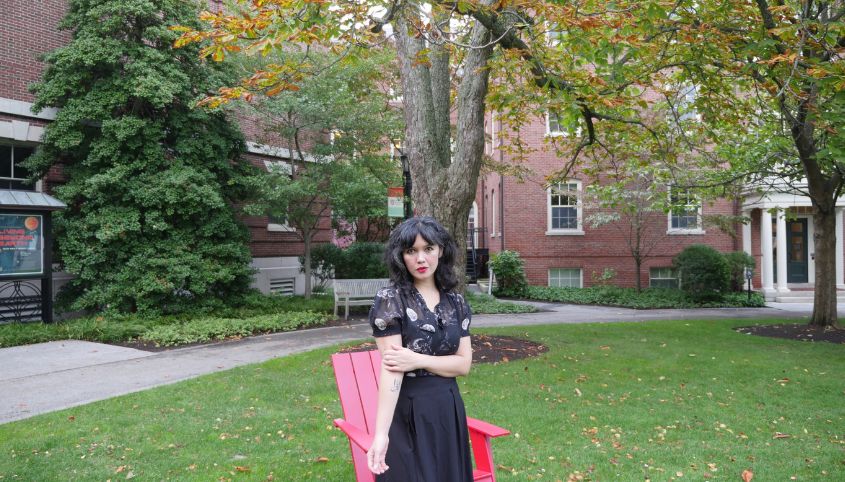 Dr Paramaditha has become one of Indonesia’s most recognised feminist writers. Image: supplied
“I grew up as an angry feminist, knowing what the women around me had to endure in a patriarchal society,” reflects Dr Paramaditha.
“But I want to be precise about which feminism I mean. I mean a feminism that is anti-patriarchal, anti-racist, anti-capitalist, and anti-colonial at once—from Audre Lorde and Angela Davis to Chandra Mohanty, and to Indonesian thinkers like the Sulawesi theologian Marianne Katoppo.”
One woman, in particular, has been instrumental in shaping both her work and activism: Dr Paramaditha’s mother.
Raised in Jakarta, Indonesia’s bustling capital, Dr Paramaditha’s mother taught her how to fight – first quite literally, then through language, when, at nine years old, she was given a typewriter.
But it quickly became a tool for far more.
A naturally shy child, it was through this typewriter that Dr Paramaditha began to find her own voice, writing against the inequalities she observed and questioning the familiar scripts of passive princesses and wicked witches told to her from an early age.
“My writing journey began with my mother,” reflects Paramaditha.
“My mother wasn't a writer herself, but she loved making up her own stories. She ended up becoming the model for the disobedient women who run through everything I've written since.
“For me, writing and resisting have always been intertwined. I don't think I ever drew a clean line between the two.”
This refusal to separate art from activism has carried Dr Paramaditha’s work far beyond Indonesia.
Recently awarded the prestigious Harvard Radcliffe Fellowship – an honour with an acceptance rate of around three per cent – Dr Paramaditha is spending the year continuing a body of work that has been building for decades.
Her new novel, Night of a Thousand Hells, has also been shortlisted for the prestigious National Book Award for Translated Literature in the United States, bringing her stories of Indonesian women, migration, sisterhood and political violence to an even wider audience.
“I grew up as an angry feminist, knowing what the women around me had to endure in a patriarchal society." - Dr Paramaditha.
Yet for all the distance her work has travelled, Indonesia remains at its heart – both as the place where her own feminist consciousness was formed and as the political and cultural landscape she continues to return.
“In my own country, learning about women writers from the past, especially the leftist ones, requires a long, collective process of digging the graves,’ explains Dr Paramaditha.
“I came of age in the twilight of Suharto's New Order and the beginning of Reformasi in 1998. I was shaped by the keywords thrown into the public sphere the moment the regime fell: freedom of expression, resistance, critical thinking. Those were the mantras of the student movement, and they coincided with everything else that forms you at that age.
“Indonesia is the political site I keep returning to. That's also why my activist work stays rooted there.”
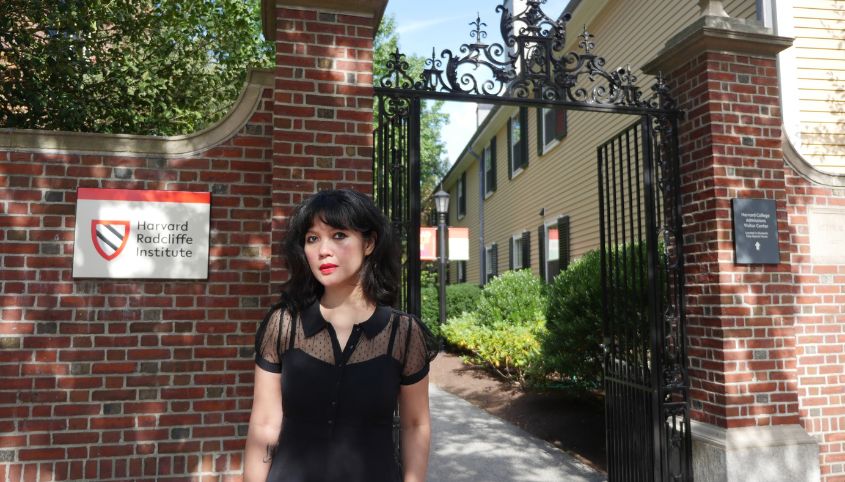
Dr Paramaditha’s writing journey began with her mother. Image: supplied
Within Harvard’s Schlesinger Library, where generations of women’s history have been carefully preserved, Dr Paramaditha has found the time and community to allow these stories to surface.
In what she describes as a “convergence” of her previous work, her time at Harvard has become a meeting point between academia and instinct. Where the archive offers fragments, fiction becomes the means of weaving them into the present.
“The erasure is still operative,” she explains.
“1965 is not over; we are not reflecting on it from a safe distance. The feminist genealogy destroyed then—a tradition of socialist feminist thought linking Indonesian women's struggles to anti-colonial movements across Asia, Africa, and Latin America – has not been restored. Contemporary Indonesian feminists inherit a broken lineage.
“Recovering these stories is the work of summoning a new coven of literary witches. The novel asks what it means to become the heir of feminist predecessors whose voices were systematically destroyed.”
Despite the difficult emotions this process may evoke, Dr Paramaditha approaches this work through the lens of kerendahan hati radikal – literally translating to “radical humility”.
“It’s the recognition that the knowledge we produce, whether through scholarly or creative work, is always a fragment of something greater that we will never fully capture,” she reflects.
“And that we cannot solve the loss. We cannot repair the incompleteness left by erasure and epistemic violence. We can only work honestly within it and make that incompleteness visible.”
Perhaps this is where the threads of Dr Paramaditha’s work meet most clearly: in the space between finding her own voice and amplifying those of past and present.
In doing so, it’s easy to feel the line between Jakarta and Harvard begin to blur – taking us back to a little girl and her typewriter, rebelling against a world that had not yet made space for her voice to be heard.
“She would ask one question: tell me how you got there?”
“And I'd say: persistence. The persistence to keep learning and interrogating, to resist, to fight erasure - in the archives, in the institutions, on the page. To understand that writing and resistance were never two different things.
“She'd recognise that. It's what she already believed. She just didn't yet know it was enough.”
Every girl deserves the space to be heard. Learn more about International Day of the Girl and the global movement working to amplify girls’ voices and shape a more equal future: [Learn more here].