
On the western bank of the Nile, the landscape changes quickly. The air hangs heavy with both mystery and heat, throwing predictability to the wind.
Beyond the river’s green strip of farmland, the desert rises towards the Theban hills, where tombs have been carved into the limestone for thousands of years, making the way archaeologists approach the site just as important as the discoveries themselves.
Here, burial places, ancient pathways and fragments of everyday life disperse across the dry landscape – a place shaped by generations of people not only remembering the ancestors who have passed but create a ceremonial bridge between this life and the next.
Macquarie University student Leonie van den Berg had never imagined she would study archaeology, let alone travel across the world for her master’s thesis. And yet, that’s exactly where she found herself: in the beating heart of Dra Abu el-Naga – an ancient Egyptian necropolis where kings, royal family members, priests and high-ranking officials were buried.
While the groundwork for her learning formed in the classroom, it’s here that her research began to take shape during this first excavation of ancient Egyptian pottery.
“I was approached by Dr Karin Sowada to go on this trip,” explains van den Berg.
“I did my internship with Dr Sowada. The internship focused on pottery from Theban Tomb 147, near the tomb I am working on for my thesis (Theban Tomb 149). I worked on the pottery collection database and helped prepare it for publication.”
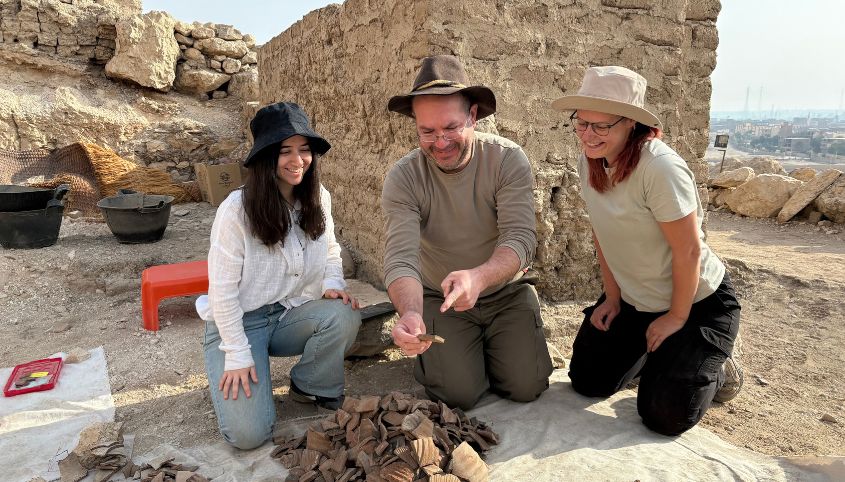 Kerri-Ann Meakins (left) and Leonie van den Berg (right) with Dr Thomas Beckh on-site pottery identification and analysis. Image: supplied by Karin Sowada
At first glance, pottery fragments might seem unassuming, but look a little closer, and they become powerful images of the past – pieced together, they can draw on history, contemporary political references and personal recollections to tell powerful narratives. For van den Berg, that prompted her to look for the deeper meanings hidden in the collection, in ways that had never been done before.
“The idea was to look at a pottery collection that was big enough, but not too big, for a master’s thesis. The advantage was that I could go with them to Egypt and actually look at the pottery in person before starting to work on it,” explains van den Berg.
“My research question is looking at whether this pottery deposit is the result of funerary rituals?”
“There are other people now starting to look into it, but it’s still quite new - I think that slowly getting to the point where I can say which one of the two it is. At the moment, I’m leaning more towards cultic pottery, which by definition refers to ceramic material deposited during ritual activity directed at the deceased after the burial, accumulating as the product of repeated offerings associated with ongoing tomb cults and festivals rather than a single funerary event.”
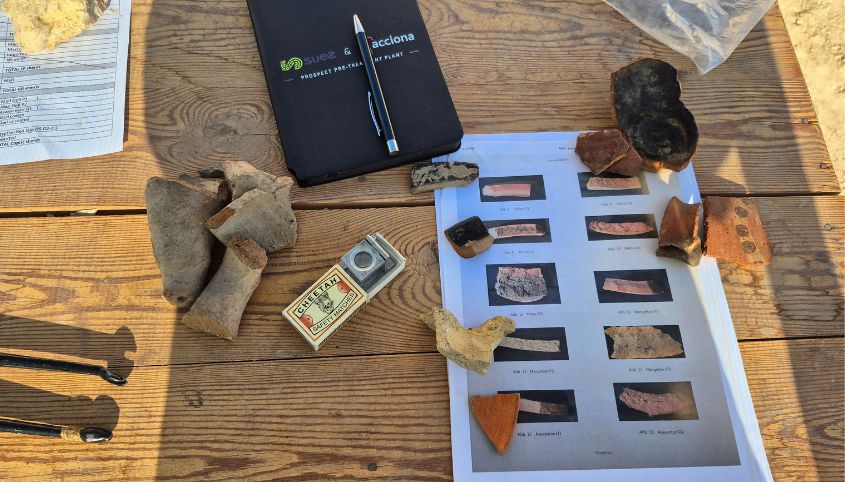 Leonie van de Berg's research search question is looking at whether this pottery deposit is the result of funerary rituals. Image: Leonie van den Berg
Part of this experience was, of course, learning from local Egyptians – and learning how to approach her search for answers through a culturally sensitive lens, with an awareness of how personal biases could potentially shape or limit her interpretation of the past.
“If you look at pottery online, someone has already put their interpretation onto it. You’re going off their drawings and pictures, and they may have missed something, especially if the documentation was done a really long time ago.
“You have to be really careful with your interpretations and also some of the words that you use.
“That means, where possible, I’m trying to use, or at least show, the ancient Egyptian words for things and say, “we don’t have a proper translation for this, but these are terms that Western scholars have used.'”
“We also have Egyptian workers on site. Just talking to them is really useful and interesting because they are locals who have been working and living in this area for generations. I really tried to soak up as much of their knowledge and their way of thinking about it as possible.”
That experience also showed van den Berg that she wanted to focus her career on understanding the ancient world through the study of pottery.
Being in Egypt gave her the chance to learn on the job, work alongside people with a deep connection to the site and see the discipline beyond the classroom.
And perhaps most importantly, it showed her that you don’t need to know everything before you start.
“Before I went to Egypt, I didn’t even know how to draw pottery. I’ve done a course now here, and I’ve watched them draw pottery on site, but before that, I didn’t know how to do it. And yet, I was still asked to come on the trip," reflects van den Berg.
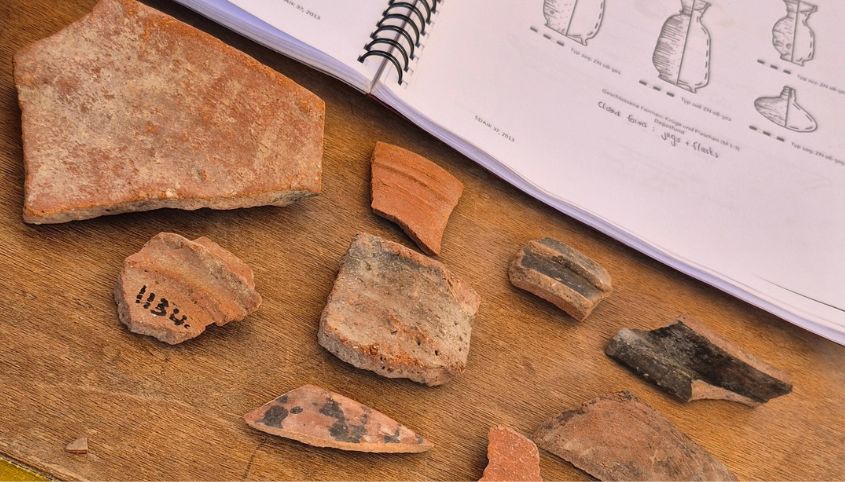 Leonie van den Berg's experience in Egypt showed her that she wanted to focus her career on understanding the ancient world. Image: Leonie van den Berg
“My advice to other students would be to just put yourself out there. Talk to people, talk to other students and talk to your teachers.
“If you have the passion for it, people will see it, and they’ll want to work with you.
Looking ahead, van den Berg is excited to finish her master’s and take part in more excavations, continuing to learn beyond the classroom and getting closer to the places and people behind the stories she studies.
Similar to the history she is trying to piece together, therein lies the beauty of such a broad discipline: there is no neat ending, but fragments of lives that are still waiting to be understood – all that’s left of the generation of archaeologists ready to pick up the clues scattered across the desert floor.
“Archaeology will always be around. In Egypt, for example, there are so many sites that need to be excavated,” says van den Berg.
“There are also sites that have been left on purpose because people know that the technology they had 10 or 20 years ago wasn’t good enough to do it properly, so they’re leaving it until the technology is good enough.
“And so, there will be enough work and opportunities for the next generations to come.”