
Here is a fact that will likely not shock you: maths, like many corners of STEM, is still overwhelmingly male.
Women make up around 35 per cent of STEM graduates globally. By the time those graduates enter the workforce, that figure falls to roughly 28 per cent – a stubborn gap that has barely shifted in recent years, even as women and men enrol in university in roughly equal numbers.
Macquarie University student Sarah Haidar knows these statistics well.
As a recent graduate of Macquarie University, her double degree in Actuarial Studies and Statistics has recently seen her accepted into Oxford’s prestigious master's program in statistical science.
But overcoming the barriers she automatically faced because of her gender was far from a matter of odds or chance. With a fierce determination, she has carved out her own path – refusing to let being an outlier stop her from moving forward.
We meet at the Cult Café within the Arts Precinct, as she tells me how the journey started. Unsurprisingly, her source of inspiration threads back to another woman in the field.
“In Year 10 I had my first female maths teacher, and she was really tough, but she had this aura and way of presenting herself where she was clear, had an admirable way of thinking, and demonstrated intelligence in a way I'd never encountered face to face before,” reflects Haidar.
“I just thought, ‘she is so cool, I want to be like her.’
“And then I started to find maths really fun and enjoyable. For me, it’s not like English – where you might need multiple perspectives – there is instant gratification. And so, when I finished year 12, I knew that I didn’t want this to be the end – I wanted to keep doing maths – from there I went to university.”
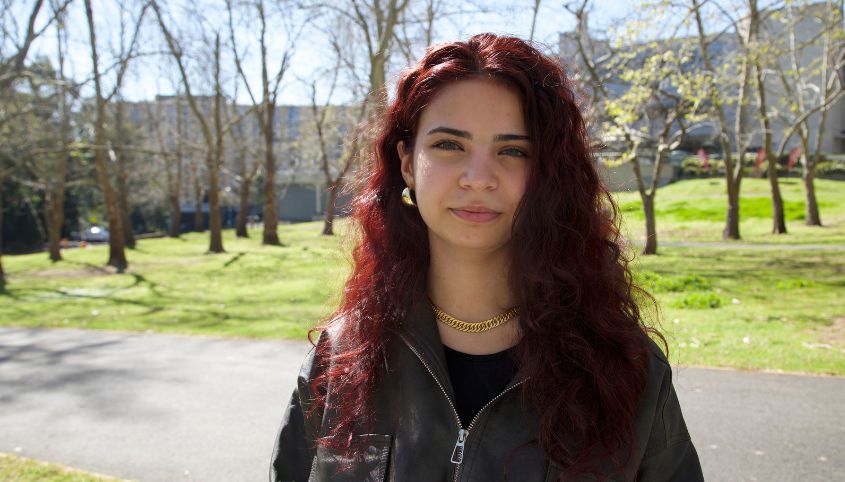
Macquarie University student Sarah Haidar. Image: Elaine Obran
She laughs as she recalls an experience that could, at times, feel isolating. But beneath the humour lies something many women in male-dominated fields will recognise - an unfortunate familiarity that stretches from classrooms to workplaces and beyond.
“There are girls in class, but sometimes, I think that they can be too shy to attend,” says Haidar.
“When I do go, if there are 20 students, and I'm one of two girls, it can be difficult to participate
“As maths people, we already aren’t talkative, and there's nothing really to discuss from class because there aren't perspectives to take.
“I did manage to make friends through the Maths and Stats Society – without that, I would have found it hard.”
At times, Haidar found that her presence in male dominated spaces was enough to make her question whether she belonged.
The assumptions could be subtle – a surprised reaction, a raised eyebrow, a backhanded compliment or an innocuous question – subtle discrimination lurking ominously in the shadows of life’s glittery moments.
“I remember the first time I came first in one of my classes; I went to the award ceremony and saw a guy there from one of my classes – he asked me, what are you doing here?" And I was like, "I came first." He's like, "Oh, okay, yeah.”
"Or, after my conditional offer and acceptance of my master’s degree, "That's nice but is it realistic?" or "Aren't you being too optimistic?"
“I think I have been underestimated my whole life – but I don’t care, I don’t let that stop me at all.”
But in moments when she does need additional support, Haidar doesn’t let the fact that female mathematicians are few and far between in her day-to-day life stop her. She knows role models can be found in unexpected places - even, quite literally, among the stars.
“I think it is important to know that you aren't alone, and there are so many great female role models in maths,” reflects Haidar.
“For example, there is a recent photo of a NASA astronaut Christina Koch. There's a photo of Earth, but her braid covers it, and she thought it was a bad photo, but it's actually a really good one."
“It shows that women get to be in those roles, and we're told that we're a waste of space, but that photo shows that her presence is important – that she's made it.”
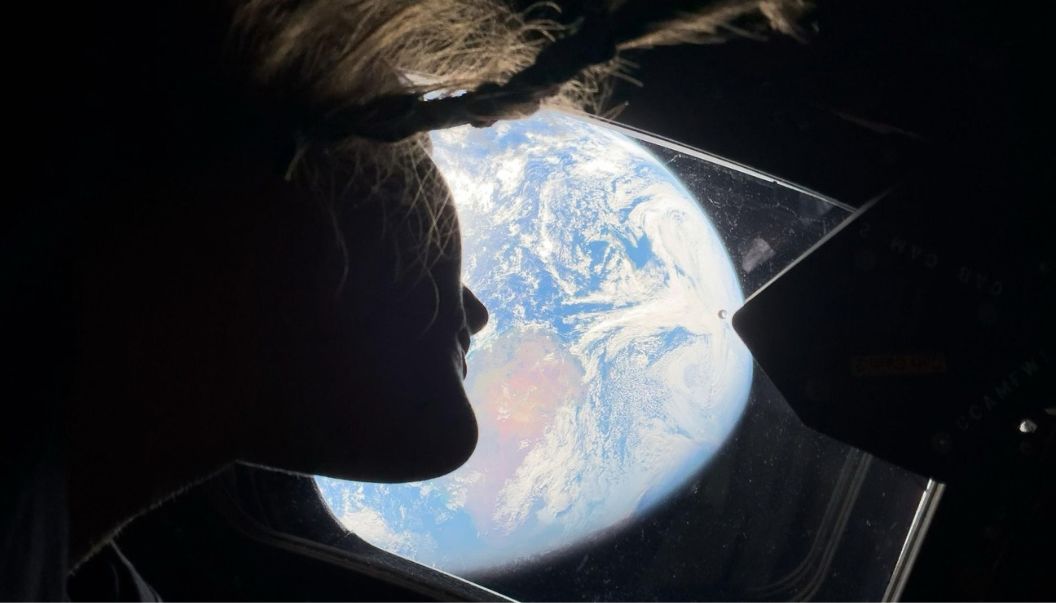 Christina Koch looking out at Earth from the Orion spacecraft during the Artemis II mission, with her braided hair floating in zero gravity. Image: @astro_christina
However, female braids covering the surface of the Earth are only part of the equation. Just as important is making sure women have the support to get there.
For Haidar, that’s where Girls to Graduates came in.
Designed to help female students build connections, develop research skills, and gain the confidence and experience to take their next steps beyond university, Haidar found both support and a community of other women through the program.
“It really helped me a lot because it was the beginning of getting into a lot of research for me. Without that, I don't think I would have done as much research as I have. We also had things like checkpoints and workshops.
“Working closely with a professor as well is very important because when you apply for a master's, you have to get reference letters. The professor I worked with for Girls to Graduates wrote one of those.
“He's spent 50 hours one-on-one with me through the program; he's seen that I can handle independent research, so he can vouch for me – especially because I'm a really shy person, so I don’t think I would have formed that connection with a teacher in class.”
That support has also shaped Haidar’s passion for giving back.
Throughout her undergraduate studies, she began volunteering at schools, speaking to students about her career and what it is like to study maths. In those classrooms, she started to recognise something familiar: the same uncertainty she once felt, now reflected in the questions of girls wondering whether a future in maths could belong to them.
Like her Year 10 maths teacher before her, Haidar believes the answer lies in representation.
“A lot of girls would come up to me and ask, "Can I do that?"
“I'm like, "Yeah, you can, actually," because they just don't consider it.
“I can't fail them. I know exactly what they're seeing, and it's what I saw in my year 10 maths teacher. It makes me want to try even harder and not give up.”