
Leading synthetic biologists have shared hard-won lessons from their decade-long quest to build the world’s first synthetic eukaryotic genome in a Nature Biotechnology paper out today. Their insights could accelerate development of the next generation of engineered organisms, from climate-resilient crops to custom-built cell factories.
“We’ve assembled a comprehensive overview of the literature on how to build a life form where we review what went right – but also what went wrong,” says Dr Paige Erpf, lead author of the paper and postdoctoral researcher at Macquarie University’s School of Natural Sciences and the Australian Research Council (ARC) Centre of Excellence in Synthetic Biology.
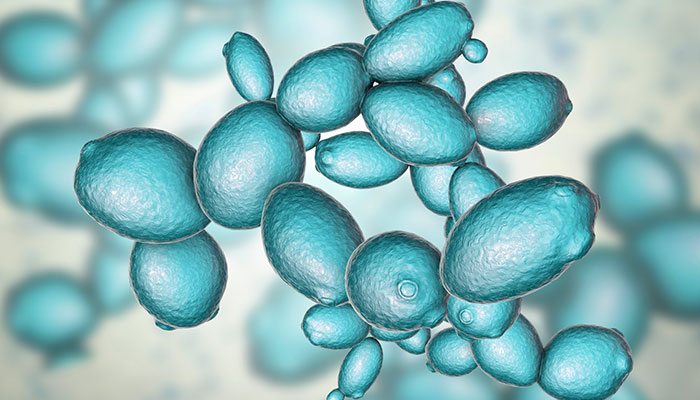
Baker's yeast: The single-celled fungus Saccharomyces cerevisiae, pictured, became the first eukaryotic organism to have its entire genome chemically synthesised and redesigned from scratch by the international Sc2.0 consortium.
She says the paper delivers a systematic account of failure and success in equal measure: for every elegant solution, the team have also documented the messy trial and error that preceded it.
“Our hope is this can help future genome builders to avoid the same pitfalls and reach their goals faster.”
The Synthetic Yeast Genome Project (Sc2.0) involved a large, evolving global consortium of 200-plus researchers from more than ten institutions, who jointly set out to redesign and chemically synthesise all 16 chromosomes of baker’s yeast from scratch.
Macquarie University contributed to the synthesis of two of these chromosomes, comprising around 12 per cent of the project overall.
Completion of the sixteenth and final synthetic chromosome finalised the project earlier this year.
The process for each chromosome had followed the same design principles: removing unstable genetic elements; introducing molecular ‘watermarks’ to distinguish synthetic DNA from natural sequences; and adding the gene-shuffling system ‘SCRaMbLE’ so researchers could rearrange genes and test their functions.
Rewriting the blueprint
Unlike traditional genetic engineering, which tweaks existing genomes, Sc2.0 was the first to rewrite an entire genome from the ground up – all 12 million base pairs of it.
“Completing all 16 synthetic chromosomes lets us understand genome function at a scale that was simply impossible before,” says Distinguished Professor Ian Paulsen, director of the ARC Centre of Excellence in Synthetic Biology at Macquarie.
“Our centre is now at the forefront of applying these insights to engineer organisms that address real-world challenges, whether that’s in sustainable manufacturing to food security.”
The chromosomes were assembled in large chunks containing thousands of base pairs, then integrated into living yeast cells step by step, relying on yeast’s own cellular machinery to stitch the synthetic pieces into place.
Learning from mistakes
Despite the standardised design principles, every research team encountered similar problems. The paper catalogues these ‘bugs’ systematically, offering future synthetic biologists a roadmap of what to avoid.
Tiny DNA watermarks, designed to be silent, occasionally disrupted gene function in unexpected ways. Some genes flagged as non-essential turned out to cause significant growth problems when removed. Taking out certain RNA genes led cells to make other, unanticipated changes; deleting others affected the function of mitochondria.
Yeast cannot regenerate mitochondrial genomes from scratch, so any damage required researchers to perform a genetic rescue operation, where they identified and fixed the problem, then had to reintroduce healthy mitochondria through careful breeding.
Much of the redesign at a genetic level was done manually. “The whole process caused a lot of headaches,” Dr Erpf says.
Teams developed and shared sophisticated debugging tools, such as ‘Pooled PCRtag Mapping’’, (which allows researchers to screen hundreds of yeast colonies simultaneously to pinpoint which genetic changes caused problems) and ‘CRISPR D-BUGS’ (combines gene editing with selection strategies).
Dr Hugh Goold led work on synXVI, one of Macquarie’s synthetic chromosomes, for the NSW Department of Primary Industries and Regional Development. He says the project’s huge scope and painstaking pace combined to form their own challenge.
“The hardest challenges were both psychological and technical: the long haul of a decade-long project where progress could feel painfully slow, and the difficulty of working with cells that were unfit and difficult to grow,” says Dr Goold.
“Because yeast is what we call an ‘easy-mode’ organism , we expect this foundational project to form the basis for similar approaches that deepen our understanding of cell biology underpinning agricultural productivity, from how weeds evolve herbicide resistance to learning the genetic basis for climate resilience in food crops.”
Next-generation crops
The lessons from yeast are already informing bold new projects.
A Macquarie research team led by Dr Briardo Lorente and Distinguished Professor Ian Paulsen from the Australian Genome Foundry recently began work on building the world’s first synthetic crop chromosome, part of a AUD $24 million / £12 million UK-funded effort to develop the technology to create synthetic plant genomes.
Plants grow slowly and are far more difficult to engineer than yeast, so this project uses an ingenious approach: building the synthetic plant chromosomes inside yeast cells first, then transferring the newly constructed chromosome into plant cells.
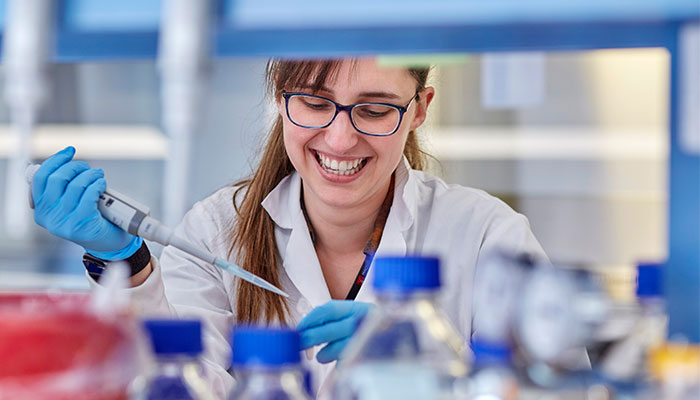
Learning from bugs: Pictured: Dr Paige Erpf, lead author of the Nature Biotechnology paper, who says documenting what went wrong during synthetic yeast construction as well as the successful outcomes, will be valuable for future genome engineers.
“Building a synthetic chromosome inside a plant is going to be really slow and difficult, but we know how to do it inside yeast,” Dr Erpf says. “This will fast-track the process.”
The project pushes the current boundaries of plant synthetic biology now, exploring large-scale genome redesigns that could help agriculture adapt to a changing climate.
Dr Goold says the technical challenges mastered while constructing synthetic yeast chromosomes are informing the approach to synthetic plant genomes.
“The ‘learning by building’ approach taken by the Sc2.0 consortium gave us incredible insights into genetics that we may not have fully grasped had we taken historical step-by-step approaches,” Dr Goold adds.
The team’s reward for these years of painstaking work is a series of final synthetic yeast strains that are as safe and easy to grow as the standard baker’s yeast they were modelled on.
But the biggest lessons from this project may still be to come. “Putting all the synthetic DNA into a single cell will be a momentous occasion and will lead to even deeper understanding of the biology that underpins our environment, our food systems and our medicines,” says Dr Goold.
The paper 'Building synthetic chromosomes one yeast at a time: insights from Sc2.0', is published in Nature Biotechnology on 11 December 2025.
Dr Paige Erpf is a synthetic biologist in the ARC Centre of Excellence in Synthetic Biology and a 2025 Superstar of Stem.
Dr Hugh Goold is an Honorary Postdoctoral Fellow in synthetic biology in the School of Natural Sciences and a Professional Officer in the NSW Department of Primary Industries and Regional Development.
Distinguished Professor Ian Paulsen is Director of the ARC Centre of Excellence in Synthetic Biology and a world-leading microbiologist.
Professor Sakkie Pretorius is Deputy Vice-Chancellor, Research at Macquarie University and an internationally recognised pioneer in molecular microbiology and biotechnology.
Associate Professor Briardo Lorente is Chief Scientist of the Australian Genome Foundry (AGF), and a leader in synthetic biology