
Macquarie University has named its newest resident – a baby echidna called spike. Spike has spent the past two months snuggled in their mother’s pouch, but now, developing spikes, the puggle is packing up to face the outside world.
"Spike is curious, cute, and cuddly," said School of Natural Sciences Fellow, Dr Oliver Griffith. "Mum visits regularly to provide food for the growing puggle, and it's wonderful to see their close bond. It's still too early to determine Spike's sex, which becomes easier to identify as echidnas mature."
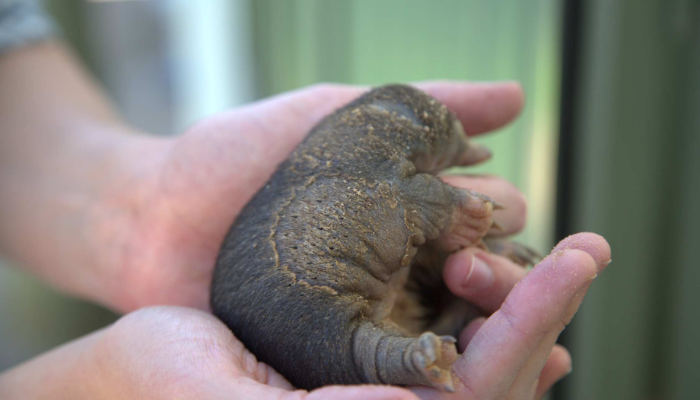
Spike the baby echidna. Photo: Supplied
The puggle’s arrival is the result of years of work by Macquarie University researchers, who care for nine echidnas and have been working to understand their behaviour and reproductive biology, including how they choose a mate. Researchers created opportunities for the echidnas to choose their own partners while observing their natural behaviours, a process affectionately dubbed “Echidna Love Island”.
Echidnas are among the few mammals that lay eggs, giving scientists a unique window into mammalian evolution. Macquarie researchers are studying these remarkable animals to better understand the diversity of reproductive systems in mammals today, including humans.
“Echidnas give us this really unique opportunity as egg-laying mammals to understand the egg laying ancestor that we had some 200-million years ago.” Said Oliver Griffith from the Macquarie University School of Natural Sciences. “By understanding what is different and what is shared between echidnas and other mammals, we can investigate how reproductive systems evolved, including the biology that underpins pregnancy and reproduction in humans.”
It’s the first time an echidna has been born at a university anywhere in the world, providing Macquarie researchers with a rare opportunity to follow the development of a puggle from its earliest days.
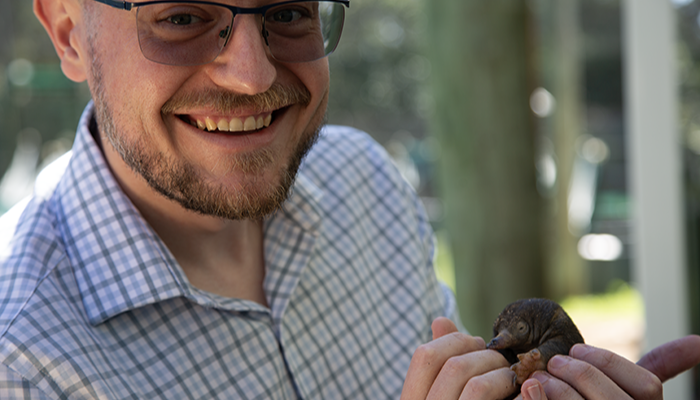
Dr Oliver Griffith, School of Natural Sciences Fellow, holds Spike the baby echidna in Macquarie University's Fauna Park. Picture: Supplied
The research is supported by Macquarie University’s Fauna Park, which provides a home for wildlife and a unique environment for researchers and students to study Australian animals. The University’s campus brings together wildlife care, scientific research and teaching, allowing researchers to study these remarkable animals while supporting their conservation.
Both Spike and mother are doing well, and the newly spiky puggle is now beginning the next chapter of its life outside the pouch – with a new name to match.