
Picture, for a moment, that you are sitting outside in the sun. Hold a coin between your fingers and raise it towards the sky. From Earth, the coin is just the right size to swallow the Sun whole.
Now, let’s take it a step further.
Forget the coin - imagine instead a star so enormous, and so unnervingly close, that it fills almost one-sixth of the sky. Not the distant pinprick of light our Sun appears to be from Earth, but a vast, burning disc hanging overhead.
Now, let’s imagine that star beginning to set.
While we are accustomed to the Sun’s daily rhythms, on a planet such as this, a sunset could stretch for hours, with the star slowly sinking towards the horizon in what might feel like a never-ending fade of light.
“I love these types of thought experiments,” says Macquarie University PhD student Mradumay Sadh, briefly taking us inside the way his mind works before bringing us back to reality.
As an astrophysics researcher, Sadh spends much of his time buried in calculations, trying to understand how light, radiation and geometry behave in planetary systems.
His research explores what happens when planets exist in extreme environments created by stars that are much larger, hotter or closer than our Sun. In doing so, Sadh is trying to understand what these worlds might teach us about the one we call home.
“By understanding the other planets, we kind of understand how our Earth evolves, and how unique our Earth is,” says Sadh.
So, Sadh looks beyond our own solar system, towards exoplanets orbiting distant stars. Some are vast gas giants; others may be rocky bodies scorched by their stars. Together, they reveal just how many ways a planet can be, well, a planet.
“It is still a mystery how life evolved on Earth because we only have theoretical model predictions. Unless we can access data from the past, we cannot really robustly say that this is how life started,” explains Sadh.
“My research tackles this problem of calculating the radiation. If a planet is very close to its star, what would the radiation be like?”
The further Sadh ventures from our familiar corner of the universe, the more the rules begin to shift, with just a small change in distance creating radically different conditions.
“Let’s imagine that you know the distance from the Sun to Earth – in technical terms, it’s one astronomical unit. The radiation felt at a distance that is one percent of 1 AU is completely different from the radiation felt on Earth. That changes the physical laws that we use to model and understand the climate of these planets.”
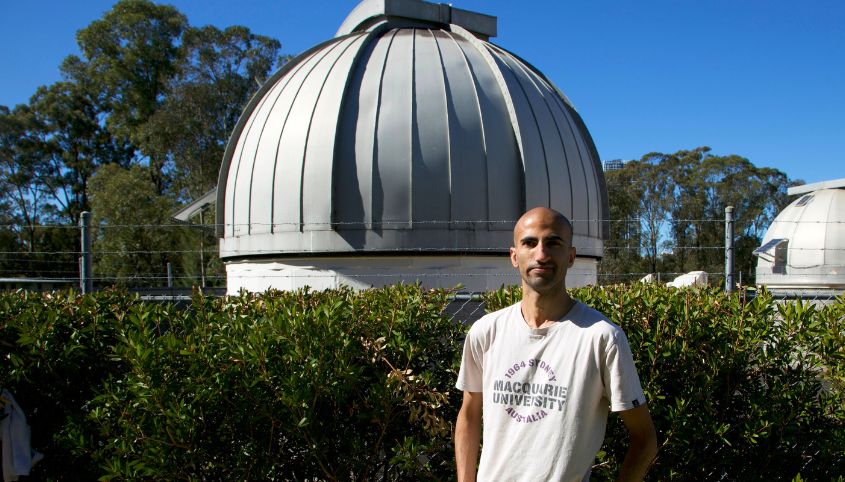
As an astrophysics researcher, Mradumay spends much of his time buried in calculations. Image: Elaine Obran
It is this willingness to question what seems familiar that has followed Sadh beyond the stars and back to his own beginnings.
Growing up in a small town in India, astrophysics was far from an obvious career path. Even pursuing high-quality education was not necessarily a given, let alone choosing a field where the career path was uncertain.
But Sadh imagined a future in the field anyway, eventually completing his master’s degree before continuing his journey to Australia.
“I grew up in a normal middle-income household,” reflects Sadh.
“The reality of that kind of income bracket is that not a lot of people pursue ambitious fields like astrophysics, or even arts or other fields which promise fewer employment opportunities.”
“I think I'm the only astronomer in my city within my age group. And this is a city of 2.5 million people.”
While it is easy to romanticise studying distant stars and imagining alien skies, Sadh doesn’t downplay the hard work it has taken to get here – a humbling reminder that a PhD still has to be done one equation at a time, often beneath the fluorescent lights of Macquarie’s library rather than the night sky.
“More times than not, I’m more frustrated than excited,” explains Sadh.
“I have been in my own headspace trying to figure out the equations and the mathematics all by myself. It’s been quite a while since I've been working on this problem.
“Almost seven years ago, a researcher did her PhD thesis on this exact topic, and there was a mistake in her thesis.
“I took some time to understand what was happening, and that was really frustrating, as there was a mismatch between the way I approached the problem and the way other researchers had approached the problem.
“But I ended up finding the mistake in that research. That was a really exciting moment. From there, I submitted my paper and got it published.”
While there is no telling where Sadh’s curiosity might take him after graduation, for now, he is focused on doing the best research he can, leaving room for curiosity to lead the way - one coin held to the Earth’s Sun at a time.
“I think what kept me going was this drive that I have to find the answer,” says Sadh.
“Even though I had made mistakes, one of the things which I learned, and I would like to share, is that I allowed myself to make mistakes.
“That was a turning point for me because if I'm very strict about not allowing myself to make mistakes, it puts me in a very narrow corner.
“Now, if I make a mistake, I just laugh - it’s okay. I'm human. I think resilience and tenacity are more important in my journey than intelligence.”