
My first camping trip didn’t quite go according to plan. I was about five or six and went with my family to Megalong Valley in the Blue Mountains. We didn’t have a four-wheel drive, but my father was ambitious enough to get his two-wheel drive down a fire trail.
It must have been Easter because I remember we did the egg hunt, with colourful foil scattered across the natural backdrop. We went on walks and, as a young kid, it felt so exploratory, although I am sure we were probably on well-trodden tracks.
It all ended in tears when I caught a bug from the water. The next 24 hours weren’t pretty, but it didn’t dampen my enthusiasm for conservation.

John Macris is a Biodiversity Adviser at Macquarie University.
I have always been really fascinated by maps. Growing up at the southern end of Sydney, you could see the Royal National Park across the waterway from our place. I would climb trees and look across the water, wondering how far the parkland went and whether it connected to the bush on the South Coast where we would often holiday. Then I would look it up on maps and it would always have me captivated.
The map I am concerned with most at the moment shows an ariel view of the Turpentine-Ironbark Forest, located on the northwest corner of campus. The restoration of this endangered habitat has been one of my key priorities at Macquarie over the past fifteen years.
The forest was in a really sorry state when I started my role in 2009. About 60 per cent of the 3.5-hecatre plot was crowded out with weeds. We’ve removed those woody weeds, and the forest has slowly come back to life.
This result gave us confidence to put the site forward as one of the target areas of the University’s new sustainability-linked loan (SLL) in 2023. The project has since been highly commended in the 2025 Australasian Green Gown Awards.
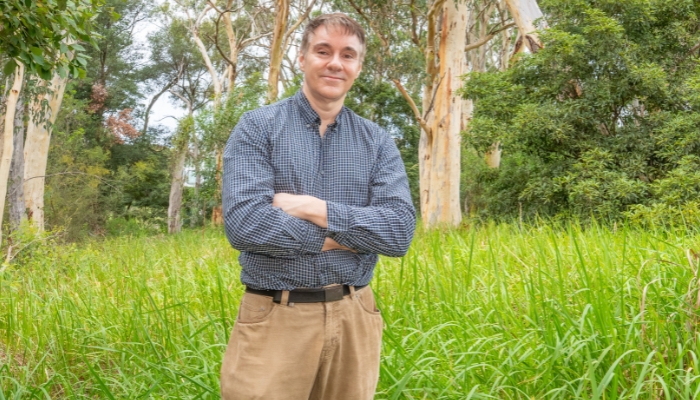
John Macris on Macquarie's Wallumattagal Campus.
Our plan over the next few years includes increasing the high and very high integrity forest area. This echoes the work we did with Mars Creek, a program that has progressively led to over a hectare of vegetation that wasn’t here before I started. We have watched bare ground become young forest environments with animals moving back in, including the blue fairy wren and the red-browed finch.
In a similar way, we hope to see the powerful owl return to the Turpentine-Ironbark Forest through the SLL-aligned restoration, as well as a vastly improved habitat for the aptly named superb fairy wren.
The University is the second organisation in the country to include biodiversity in its SLL framework. It’s great that Macquarie has committed to going above and beyond business as usual. It’s a driving reason behind our recent induction into the Nature Positive Universities Network. Last year we were also ranked first in Australia for campus biodiversity. There is much to be proud of.
We have an incredible campus. I look around and I see a jigsaw puzzle of various influences over time. Those layers keep it interesting, and they are all worth looking after.